Visiting a Doctor In Germany [2026 Guide]
Book a German doctor appointment in 3 steps. Learn how Kassenärztliche works, what to bring, and avoid the 4 most common expat mistakes.
Seeing a doctor in Germany is straightforward once you understand how the system works, and for most residents covered by gesetzliche Krankenversicherung (statutory health insurance), a standard GP visit costs nothing out of pocket. According to GKV-Spitzenverband, around 73 million people in Germany were enrolled in statutory health insurance as of 2026, meaning the vast majority of expats, students, and employees are already covered before they ever need an appointment.
Back in 2020 in Freiburg, I came down with a stubborn fever that wouldn’t shift after four days and finally had to navigate the German healthcare system for the first time on my own. It turned out to be far less intimidating than I’d expected, though I wish someone had told me beforehand what to bring and how the whole process actually works.
That’s exactly what this guide covers. Whether you’re trying to book your first doctors appointment in Germany, figuring out whether you need a Hausarzt (family doctor/GP) or a specialist, or wondering what happens if you show up without your Krankenkassenkarte (health insurance card), this article walks you through all of it.
Gute Besserung, by the way, if you’re reading this because you actually need it right now.

Top 6 Things to Know When Visiting a Doctor in Germany
The German healthcare system works very differently from what most expats expect. Understanding a few core principles before your first doctor appointment in Germany will save you real confusion and make the whole experience far less stressful.
Quality over comfort. German hospitals and clinics prioritise effective medical treatment above all else. The rooms are functional, the atmosphere is clinical, and privacy is not always what you might be used to. This is a deliberate choice. The focus is squarely on getting you the right care, not on making you feel like a hotel guest.
Honesty is legally protected. Doctors in Germany are legally required to inform patients about their diagnosis and treatment options directly. Under § 630e BGB (the German Civil Code on patient rights), a doctor cannot withhold a diagnosis even if a family member requests it. Patients sign a written consent form (Einwilligungserklärung) before any procedure, and they have the right to ask questions at every stage.
Expect thorough questioning. German doctors take detailed medical histories seriously. Your Hausarzt (general practitioner) will ask about current medications, past conditions, allergies, and family history. Bring any previous records or specialist letters you have.
Efficiency is the standard. According to the OECD Health Statistics 2025, Germany has one of the highest doctor consultation rates in Europe at around 10 visits per person per year. The system is built to move patients through effectively without unnecessary delays, though waiting times at specialists can still run several weeks.
What we like
- High standard of medical care backed by strong regulatory oversight
- Patients have full legal rights to honest, transparent information about their diagnosis
- Statutory health insurance (Gesetzliche Krankenversicherung) covers the vast majority of treatment costs
- Dense network of doctors in Germany means access is rarely a geographic problem
What we did not like
- Waiting times for specialist appointments (Facharzt) can stretch to several weeks
- Clinical environments offer little comfort or privacy compared to private hospitals
- Navigating the system without German language skills adds real friction
Who Can Access Doctors in Germany?
In Germany, accessing a doctor requires health insurance. Full stop. Under German law, all residents are legally obligated to hold Krankenversicherung (statutory or private health insurance), and doctors will ask for proof of coverage before treating you. If you show up uninsured, you will typically be asked to pay out of pocket upfront.
According to GKV-Spitzenverband, around 73 million people in Germany were enrolled in statutory public health insurance (gesetzliche Krankenversicherung, or GKV) as of 2026. That covers the vast majority of residents, but the requirement extends to everyone living here, including expats and foreign nationals.
Visitors are a slightly different case. EU and Swiss citizens can present their EHIC (European Health Insurance Card) when making a doctor appointment in Germany, and doctors here are required to accept it. The catch is that the EHIC only covers medically necessary treatment during your stay. It is not a substitute for full resident coverage, and it will not get you into a specialist’s office for a routine check-up.
Non-EU visitors should carry travel health insurance that is valid in Germany. Without it, any doctor visit becomes a private-pay situation, and costs can climb quickly.
How To Find a Doctor in Germany
The fastest way to find a doctor in Germany is to search Google for your specialty plus your city name, for example “Allgemeinarzt Freiburg” or “Hausarzt Wolfsburg”. The Allgemeinarzt or Hausarzt (general practitioner) should always be your first stop. They handle routine illness, referrals, and sick notes, so getting one registered before you actually need them is the smartest move you can make.
If you want something more structured, the Kassenärztliche Bundesvereinigung (National Association of Statutory Health Insurance Physicians) runs an official doctor search at arztsuche.kbv.de. You can filter by specialty, location, and which Krankenkasse (statutory health insurer) a practice accepts. It is accurate, up to date, and completely free to use.
For online booking and broader discovery, two platforms worth knowing are Doctolib and Jameda. Doctolib has grown significantly in Germany and lets you book appointments directly without a phone call, which is genuinely helpful if your German is still a work in progress. Jameda functions more like a review directory, so it is useful for reading patient feedback before you commit to a practice. Zava (formerly DrEd) is a separate option for online consultations when you do not need to see someone in person.
Finding an English-Speaking Doctor
In major cities like Berlin, Munich, Frankfurt, and Hamburg, English-speaking doctors are genuinely common. In smaller cities and rural areas, it is less predictable. A practical workaround is to search Google for “Hausarzt Englisch” plus your city name. The Techniker Krankenkasse also offers a dedicated English-language doctor search tool at tk-aerztefuehrer.de that filters for English-speaking practices across Germany.
The US Embassy and the British Embassy both maintain lists of English-speaking doctors in major German cities, updated periodically. These lists are worth bookmarking even if you are neither American nor British.
If language is still a concern during appointments, bring a German-speaking friend or colleague. Even having someone on the phone who can translate a sentence or two makes a real difference. A translation app works in a pinch but is not reliable for medical terms.
Why Registering a Hausarzt Matters
One thing that catches expats off guard is the Krankheitsbescheinigung (sick note or illness certificate). If you are too ill to work in Germany, your employer does not simply take your word for it. Your Hausarzt issues the official sick note, and you are required to submit it to your employer from the first day of absence in most employment contracts, or by the third day at the latest under standard German labour law. According to the GKV-Spitzenverband, statutory health insurance covers the cost of GP consultations in full for insured members in 2026, so there is no financial reason to delay registering.
Getting yourself onto a Hausarzt’s patient list before you are sick is the sensible approach. Many practices have waiting lists, so the time to search is now, not when you have a fever.
What to Expect When Visiting a Doctor in Germany
The first thing you do at any German doctor’s office is hand over your Krankenversicherungskarte (statutory health insurance card) at reception. If it’s your first visit to that practice, you’ll also fill out a short patient registration form with your personal details and medical history. First-timers sometimes feel overwhelmed by this, but the forms are straightforward and the Arzthelfer (doctor’s assistant or medical receptionist) will guide you through it.
Waiting times vary a lot depending on the type of doctor, time of day, and how busy the practice is. Specialist appointments especially can run long. Calling ahead to ask about current wait times is always worth doing if you’re short on time.
Once you’re called in, the consultation itself tends to be efficient and direct. German doctors generally skip small talk and get straight to the point. That’s not rudeness. It’s just the professional culture here. Come prepared with your questions written down, because the appointment moves quickly and you’ll want to make the most of it.
Making an Appointment
Most doctor appointments in Germany are booked by phone. You’ll speak with the Arzthelfer, who will ask for your name, insurance details, and a rough reason for the visit. You don’t need to go into detail unless it’s something urgent or unusual. If it is urgent, say so clearly: Es ist dringend. Haben Sie keinen früheren Termin? (It’s urgent. Do you have an earlier appointment?) For a standard booking: Ich möchte einen Termin machen (I’d like to make an appointment) is all you need to start.
Many practices now also accept appointments online through platforms like Doctolib, which has expanded significantly across Germany. According to Doctolib’s own published data for 2026, over 50,000 German healthcare professionals are listed on the platform, making it a genuinely useful first stop if you’d rather not call.
Office Hours (Sprechstunden)
German doctors typically run two daily blocks: mornings from around 8am to 1pm, and afternoons from 3pm to 6pm. Wednesday afternoons are commonly closed, which catches a lot of newcomers off guard. Even if you’ve booked a slot, some practices still operate on a first-come-first-served basis within that window, particularly Hausarzt (general practitioner) offices with open-door policies. Having an appointment still gets you priority treatment in most cases.
Outside Office Hours
If something comes up outside normal hours and it’s not a life-threatening emergency, the ärztlicher Bereitschaftsdienst (out-of-hours medical service) is your first call. Reach them on 116117, available 24 hours a day. For genuine emergencies, call 112. Telemedicine consultations are also increasingly covered by statutory insurance in 2026, so your Hausarzt may be able to advise you by video call without you needing to come in at all.
Medical Specialists in Germany
Seeing a Facharzt (medical specialist) in Germany is straightforward in principle, though waiting times can vary wildly depending on the specialty and where you live. Some specialists will see you within a week. Others, particularly psychiatrists and orthopedic surgeons, can have wait times stretching to several months. Urgency does play a role, so if your Hausarzt (general practitioner) flags something as time-sensitive, say so when you call.
Do You Need a Referral?
Not always, but it helps. You can contact many specialists directly without a referral, and most will accept you. That said, having an Überweisung (referral letter) from your GP often moves things along faster and signals to the specialist why you are there. For statutory insurance holders, a referral also avoids any administrative back-and-forth.
Finding a Specialist in Germany
The same platforms that work for finding a GP apply here. Doctolib, Jameda, and the KBV doctor search (Kassenärztliche Bundesvereinigung, the National Association of Statutory Health Insurance Physicians) all let you filter by specialty and location. Expat Facebook groups for your city are genuinely useful for finding English-speaking specialists.
Private Specialists
Some Fachärzte only see patients with private insurance (Privatversicherung). The upside is shorter waiting times and, often, a broader range of treatment options. The PBV (Privatärztlicher Bundesverband) runs a search tool specifically for private doctors across Germany.
Private hospitals and rehabilitation centers also exist, but here is where it gets counterintuitive: many private Kliniken do treat patients with statutory insurance (gesetzliche Krankenversicherung). Always call the facility directly to confirm before assuming you are not covered.
Cost of Visiting Doctors and Specialists in Germany
For most residents, the cost of seeing a doctor in Germany is effectively zero at the point of treatment. Your Krankenversicherung (statutory health insurance) covers general practitioner visits, specialist consultations, urgent care, annual checkups, and pediatric examinations. You show your Versichertenkarte (health insurance card) at reception and that is the end of the transaction.
That said, not everything is covered. According to the GKV-Spitzenverband, statutory insurance in 2026 does not cover certain preventive tests including standard hearing screenings, HPV testing outside specific age brackets, and toxoplasmosis screening during pregnancy. These come out of pocket. If you want broader coverage for things like professional teeth cleaning or premium dental work, you will need a Zahn-Zusatzversicherung (supplementary dental insurance) on top of your standard policy.
Visitors without any German health insurance have to pay upfront before receiving non-emergency treatment. Costs vary widely depending on the practice and procedure, so it is worth sorting out at minimum travel insurance before arriving.
Prescriptions and Medication
German doctors write prescriptions on a Rezept, and since 2022 the system has been transitioning to the E-Rezept (electronic prescription), which can be sent directly to any Apotheke (pharmacy). Antibiotics are prescribed far more conservatively here than in many other countries. Doctors often suggest home remedies or herbal treatments first, which surprised me when I first navigated the system in Freiburg in 2020.
Over-the-counter medicines like paracetamol, aspirin, or cough syrup are available without a prescription but are not covered by insurance. Most basic OTC packs cost under €10 at an Apotheke.
Medical Tests in Germany
German doctors tend to follow a need-based approach to testing rather than running routine panels as a matter of course. A good example: blood screening for anemia in infants is standard practice in the US, but German pediatricians typically only order it when there’s a clinical reason to suspect a problem. The system trusts that less testing, done purposefully, produces better outcomes.
If your Hausarzt (primary care doctor) decides a test is warranted, common options include blood work, urine analysis, and ultrasound, all covered by your gesetzliche Krankenversicherung (statutory health insurance). Where it gets complicated is when you want additional tests your doctor hasn’t recommended. In that case, you’ll need to advocate for yourself clearly, and if the insurer considers the test medically unnecessary, you may end up paying out of pocket.
Results handling has improved significantly. Many practices now upload results to a patient portal, and some tests, like rapid blood glucose or urine dipstick readings, give you results on the spot during the appointment. For anything sent to an external lab, expect two to five business days. According to GKV-Spitzenverband data from 2025, over 60% of statutory insurers now support digital health records that include lab results.
What is a ‘Gesundheitskarte’ and How to Get It
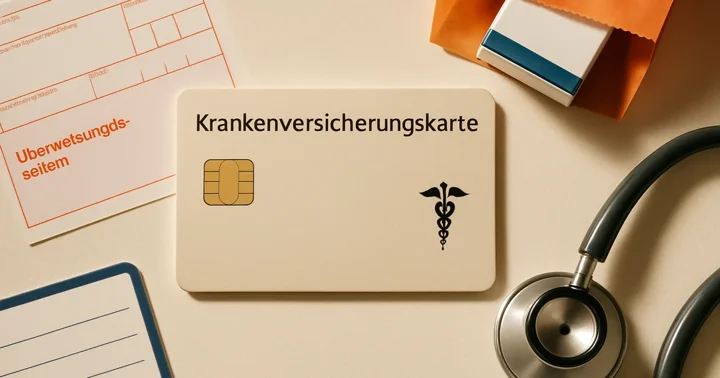
The Gesundheitskarte (health insurance card) is a small chip card that proves you have active health insurance coverage in Germany. Every time you visit a doctor in Germany, the receptionist will ask for it before anything else. No card usually means no consultation, so keep it in your wallet.
According to the GKV-Spitzenverband, around 90 percent of people in Germany are covered by statutory public health insurance (gesetzliche Krankenversicherung), with the remaining share holding private plans. Once you enrol with a public insurer like TK, AOK, or Barmer, they post your Gesundheitskarte to your registered address within a few weeks. If you need to see a doctor before it arrives, your insurer can provide a temporary confirmation letter that most practices will accept.
The card is tied to your insurance, not your employer, so it stays valid even if you change jobs as long as your coverage continues. Private patients receive a different document from their insurer instead. Worth knowing: without valid German health insurance, you are responsible for paying the full cost of any treatment yourself.
Can I see a doctor in Germany without my Gesundheitskarte?
What is Paid Sick Leave in Germany?
If you’re employed and covered by public health insurance (gesetzliche Krankenversicherung), your employer is legally required to pay your full salary for up to six weeks when you fall ill. This is known as Lohnfortzahlung (continued wage payment). To trigger it, your doctor must issue a Krankenbescheinigung (sick note) confirming your inability to work. You also need to notify your employer promptly and stay in reasonable contact during your absence.
After those six weeks, your statutory health insurer takes over and pays Krankengeld (sick pay), which under § 47 SGB V amounts to roughly 70% of your gross salary, capped at 90% of your net pay. According to GKV-Spitzenverband, this benefit can continue for up to 78 weeks for the same illness.
Self-employed people have a different situation entirely. Public health insurance does not automatically include Krankengeld for the self-employed unless you explicitly opt into it, which costs extra. Most freelancers in Germany cover this gap through private health insurance instead.
One practical tip: submit your sick note within three days of falling ill. Missing that deadline can create unnecessary complications with your employer.
How do I get a sick note from a doctor in Germany?
How do I book a doctor appointment in Germany as an expat?
Can I see a doctor in Germany without a health insurance card?
What is a guest doctor (Gastarztt) in Germany?
What is the average doctor's salary in Germany in 2026?
Do doctors in Germany speak English?

Jibran Shahid
Hi, I am Jibran, your fellow expat living in Germany since 2014. With over 11 years of personal and professional experience navigating life as a foreigner, I am dedicated to providing well-researched and practical guides to help you settle and thrive in Germany. Whether you are looking for advice on bureaucracy, accommodation, jobs, or cultural integration, I have got you covered with tips and insights tailored specifically for expats. Join me on my journey as I share valuable information to make your life in Germany easier and more enjoyable.