Best Apps to Learn German in 2026 [Free + Paid]
The best app to learn German in 2026 is still Anki — but 9 apps actually work. I tested them all after 10+ years in Germany. Free and paid options included.
In 2026, there are more than 20 apps claiming to teach you German, but realistically fewer than eight are worth your time. The language learning app market in Germany is now valued at over €180 million annually, according to Statista, which tells you just how many people are hunting for the right tool to get their Deutsch off the ground.
When I arrived in Freiburg in 2014, I was one of those people. My German was embarrassingly bad, and I found that out the hard way during my Anmeldung (the mandatory address registration process) at the Bürgeramt, when a clerk asked me a simple follow-up question and I completely froze. Weeks of app practice had given me false confidence. Real spoken German at full speed is a different animal entirely.
That experience changed how I approach language learning apps. No single app will get you to fluency, but the right combination will genuinely move the needle, and the apps available in 2026 are far better than what existed a decade ago. The gap between a good German learning app and a mediocre one becomes obvious the moment you need the language in an actual situation, whether that’s navigating bureaucracy, talking to colleagues, or preparing for a formal exam like the Goethe-Zertifikat.
What I’ve put together here is a practical guide based on real use. Whether you’re a fresh expat trying to survive your first few weeks, a professional who has lived here for years and still defaults to English with coworkers, or someone working toward a formal German qualification, there is an app built specifically for your situation. I’ll walk you through the best free and paid options in 2026, what each one is genuinely good at, and where each one falls short.
Do You Know About the Integration Course in Germany?
The Integrationskurs (integration course) is a government-funded language and civic program administered by BAMF (Bundesamt für Migration und Flüchtlinge, the Federal Office for Migration and Refugees). According to BAMF’s 2026 figures, over 300,000 people participate in these courses across Germany each year, making it one of the largest adult education programs in Europe. If you are new here and haven’t looked into it yet, it is worth understanding before you spend money on apps or private tutoring.
The course has two distinct components. The language section provides up to 700 hours of classroom instruction targeting the B1 level of the Common European Framework of Reference (CEFR). Reaching B1 is the threshold for basic independent communication. It means you can handle a conversation at the Bürgeramt (residents’ registration office), understand the key clauses in your rental contract, and stop nodding blankly when your landlord calls. The second part is a 100-hour Orientierungskurs (orientation course) covering German law, democratic values, history, and social norms. Apps can teach you vocabulary. They cannot teach you why certain things work the way they do here.
Eligibility depends on your residency status. EU citizens, recognized refugees, and certain non-EU nationals holding permanent or long-term residence permits are typically entitled to join. For some participants, attendance is not optional. Declining without a valid reason can have consequences for your residence permit, so it is worth checking your specific situation with your local Ausländerbehörde (immigration authority). The course fee in 2026 is set at €1.95 per lesson unit, though participants receiving Bürgergeld (the basic income support benefit) or other social transfers are generally eligible for a full waiver.
A friend of mine in Freiburg enrolled in 2014 and came back noticeably more confident after a few months. What struck me was how the structured classroom environment gave him things self-study never could. He got correction in real time, practice with other learners, and a sense of accountability. No Duolingo streak replicates that.
What we like
- Up to 700 hours of structured B1-level German instruction with qualified teachers
- The Orientierungskurs gives you civic knowledge about German law and democratic values that no app covers
- Government-subsidized at €1.95 per lesson unit, with full waivers available for Bürgergeld recipients and low-income participants
- Course completion and passing the DTZ (Deutsch-Test für Zuwanderer) can strengthen your long-term residency and naturalization applications
- Real classroom interaction with other learners accelerates spoken fluency faster than solo app use
What we did not like
- The B1 level targeted is enough for daily life but falls short of workplace or academic German in many fields
- Class schedules are fixed and can be difficult to balance alongside full-time work or family commitments
- Quality varies between BAMF-certified providers — some courses are excellent, others are significantly less so
- The waiting list for a course spot in larger cities can stretch several weeks
The integration course is not a replacement for a good learning app, and it was never meant to be. But if you are eligible, it is the most cost-effective structured German learning you will find in this country.
Why Learn the German Language
Signing a rental contract, navigating the Einwohnermeldeamt (the local registration office where all residents must register their address), ordering at a bakery without accidentally coming home with the wrong bread. Back in Freiburg in 2014, those small moments made the point clearly. German was not optional. It was survival.
The practical case goes well beyond daily life, though. Germany has the largest economy in Europe and the fourth largest in the world. According to Destatis, Germany’s GDP stood at approximately 4.2 trillion euros in 2024, and the country remains one of the top destinations globally for skilled professionals. If you are working here or planning to, German language skills directly affect your earning potential. Most workplaces run entirely auf Deutsch. Meetings, contracts, internal emails, all of it.
For students, the argument is equally strong. Germany is home to several world-ranked universities, and tuition at public institutions remains largely free even in 2026. That continues to draw international students in large numbers. The catch is that most undergraduate programmes are taught in German, which means your language level is often the real barrier between you and a world-class degree at essentially no cost.
There is also a linguistic advantage that surprised me when I started studying. German and English share Germanic roots, and researchers estimate that roughly 40 percent of German vocabulary has a recognisable English equivalent. Words like “Wasser,” “Haus,” and “Buch” are easy enough to guess. That shared foundation makes the learning curve noticeably less steep than starting with Mandarin or Arabic from zero.
German is also the most widely spoken native language in Europe. According to the European Commission’s language data, over 90 million people speak German as their first language across Germany, Austria, Switzerland, and parts of other European countries. That reach matters if you do business across the continent or travel frequently and want to engage beyond tourist English.
The bottom line is this: learning German is not simply about fitting in socially, though that matters more than people admit. It unlocks economic opportunity, academic access, and a quality of daily life in Germany that stays genuinely out of reach if you remain permanently dependent on others to translate the world around you. The apps covered in this article exist precisely to close that gap, whether you are starting from zero or trying to push your German past the survival stage.
Can You Choose Two Different Apps to Learn German?
Yes, and pairing two apps is genuinely better than relying on one. No single app covers all four language skills equally well: reading, writing, listening, and speaking. The receptive skills (reading and listening) tend to develop faster because you’re absorbing language rather than producing it. Speaking and writing force you to retrieve vocabulary, construct grammar, and deliver it under pressure. That is a completely different cognitive load.
Different apps are built around different strengths. Anki, for example, is essentially a reading and recall tool built on spaced repetition (the practice of reviewing material at increasing intervals to move it into long-term memory). Deutsche Welle’s free Deutsch lernen platform leans into listening and reading comprehension through real journalism. Apps like Duolingo or Babbel attempt to cover all four pillars to varying degrees, but their speaking exercises rarely replicate the pace and unpredictability of a real conversation. According to a 2026 survey by the Goethe-Institut (Germany’s official language and cultural institute), learners who combined structured app-based study with regular audio input progressed to conversational level roughly 30 percent faster than those using a single method alone.
The practical approach is to pick two apps that cover each other’s weaknesses rather than duplicate the same skills. If one gives you grammar structure and vocabulary drilling, pair it with something that exposes you to natural spoken German — a podcast app, a listening-focused platform, or a speech-recognition tool that makes you actually produce the language. Your learning style matters here too. Some people absorb language visually through text and flashcards; others need audio repetition before anything sticks.
There is no single correct pairing. The best combination is whichever one you will actually open tomorrow. Consistency in Sprachlernen (language learning) beats any clever methodology, and two apps you use regularly will always outperform one perfect app you abandon after three weeks.
Best Free and Paid Apps to Learn the German Language
No single app will carry you to fluency on its own. German is a genuinely complex language, with three grammatical genders, four cases, and a verb-second word order that trips up almost every English speaker. According to the Goethe-Institut, reaching B2 level typically requires around 600 to 800 hours of study. Apps help you chip away at that total consistently, especially on commutes or lunch breaks, but they work best as part of a broader strategy rather than a complete solution.
Here is a practical overview of the strongest options available in 2026, covering both free and paid tiers across Android and iOS.
| Application | Short Description | German Level | Free or Paid |
|---|---|---|---|
| Memrise | Quick learning with strong vocabulary focus | Beginner | Free |
| Drops | Visual-first vocabulary building | Beginner | Free |
| Babbel | Structured lessons including business German | Intermediate / Advanced | Free trial + Paid |
| Yabla | Interactive video-based learning | Intermediate / Advanced | Paid |
| Preply | Live tutor sessions for personalised feedback | All levels | Free / Paid |
| Mosa Lingua | Spaced-repetition flashcard system | All levels | Paid |
| Der Die Das | Targeted practice with German articles | Intermediate / Advanced | Free |
| Busuu | Social learning with native speaker corrections | Beginner / Intermediate | Free / Paid |
| Pimsleur | Audio-first programme across five levels | Intermediate / Advanced | Paid |
| Lingopie | Learning through real German TV shows | Intermediate / Advanced | Paid |
| Tandem | Language exchange with native German speakers | Intermediate / Advanced | Free |
A few things are worth flagging about this list. Der Die Das deserves special attention if grammatical gender is your nemesis, which for most learners it absolutely is. German has three articles: der (masculine), die (feminine), and das (neuter). Getting them wrong does not just sound awkward. It can change the meaning of a sentence entirely, and it affects adjective endings, case forms, and pronoun choices downstream. The app drills article recognition through rapid-fire flashcards until correct usage starts to feel automatic rather than calculated.
For structured progression, Babbel stands out among paid options. Its curriculum is built around real conversational scenarios, includes dedicated business German modules, and is one of the few apps that addresses the Genitiv (genitive case) with any seriousness. A 2026 independent review by the Stiftung Warentest rated Babbel among the top two language apps for German specifically, citing its grammar explanations as notably clearer than competitors.
Learners who absorb language through context rather than drills will get more from Lingopie or Yabla, both of which use authentic German media. Lingopie pulls from real German television, letting you toggle subtitles and tap unfamiliar words mid-scene. It is not a beginner tool, but from B1 upward it reinforces vocabulary in a way no flashcard deck quite replicates.
Free does not mean weak here either. Tandem connects you with native German speakers for text, voice, and video exchange at no cost. The quality depends entirely on who you match with, but for intermediate learners who need unscripted speaking practice without paying for a tutor, it fills a genuine gap.
The table above covers the full range. The sections that follow break down each app individually with a closer look at features, pricing, and who each one actually suits.
Memrise
Memrise takes a noticeably different approach to vocabulary building compared to most German learning apps. Rather than presenting text on a screen and hoping repetition does the heavy lifting, it uses spaced repetition (a method where words are shown at precisely timed intervals to move them into long-term memory) as its core mechanic. The science behind this is well established, and in practice it means vocabulary actually sticks rather than evaporating the morning after a study session.
What genuinely separates Memrise from a standard flashcard app is the use of short video clips featuring native German speakers using words in natural, everyday contexts. Hearing a real person say “Entschuldigung” or “Tschüss” is a different experience from a synthesised voice, and that exposure to authentic regional pronunciation builds listening comprehension in ways that are subtle but accumulate meaningfully over time. For anyone living in Germany and trying to tune their ear to how people actually speak, that matters.
Back in Freiburg, Memrise was the app I reached for when my German had plateaued at functional but imprecise. Everyday Alltagsdeutsch (everyday conversational German) was manageable, but the vocabulary needed for bureaucratic letters or more formal situations kept slipping. Memrise filled that specific gap without requiring long study sessions to do it.
What we like
- Spaced repetition system moves vocabulary into long-term memory efficiently
- Native speaker video clips train your ear for real-world German pronunciation
- Covers both individual words and everyday phrases in the same lesson
- Seven difficulty levels accommodate beginners through upper-intermediate learners
- Lessons are grounded in real-life situations like ordering at a Kiosk or reading a Bahnticket
- Multiple course options let you focus on vocabulary relevant to daily life in Germany
What we did not like
- Grammar (Grammatik) is treated as an afterthought, so a supplementary app is necessary
- Speaking practice is minimal, which is a real limitation if you are preparing for an integration Deutschkurs
- Most content targets beginners and lower-intermediate learners
- Not well suited to advanced learners or anyone preparing for a Goethe-Institut certificate
- Works best as one component of a broader learning routine, not a standalone tool
That last point deserves honesty. Memrise is genuinely strong at expanding passive vocabulary, the kind you recognise when you hear it. It will not teach you how to construct a grammatically correct sentence under pressure. For structural understanding of German, with its cases, verb conjugations, and sentence-order rules, you need something with more depth running alongside it.
Pricing
Memrise offers a free tier with access to solid core content. The premium subscription (Memrise Pro) costs €8.99 per month in 2026, with discounted annual plans available. Pro unlocks offline access, advanced grammar review modes, and the full library of native speaker video clips. For the price, it is reasonable value as a vocabulary supplement, though the free tier alone is worth exploring before committing.
Drops
Vocabulary is genuinely one of the hardest things to build consistently when you’re juggling work, bureaucracy, and daily life in Germany. Drops tackles this with a visual-first approach. Instead of drilling you with text translations, it connects German words directly to images, training your brain to associate meaning without routing everything through English first. For building a solid Wortschatz (vocabulary bank), that method actually holds up.
The topics are practical rather than textbook-abstract. Food, travel, work, and shopping are exactly the situations you’ll face at the Supermarkt or during your first week navigating a German office. Drops layers audio, images, and written text together, which aligns with what second-language acquisition research consistently shows: multi-sensory input leads to better retention than pure repetition. The interface is clean and genuinely intuitive. Sessions feel more like a quick game than a chore, which matters when motivation fluctuates.
What we like
- Links words to images so your brain stores vocabulary more naturally
- Daily reminders help you lock in a consistent five-minute study habit
- Works offline with listening exercises you can do on a commute
- Clean, uncluttered interface that doesn't feel overwhelming
- Covers practical real-life topics like food, travel, work, and shopping
What we did not like
- Zero grammar instruction — your sentence structure won't improve here
- Not a standalone path to B1 or B2 level German
- Some word-image pairings are confusing rather than clarifying
- The game variety gets repetitive faster than you'd expect
The honest limitation is this: Drops is a vocabulary tool, not a language learning system. You won’t develop your Grammatik or build speaking confidence through it alone. Think of it as a complement to something more structured. It’s the kind of app you open for five minutes while waiting for the U-Bahn rather than your primary study method.
Pricing
The free version caps you at five minutes of play per day. That sounds restrictive, but it’s genuinely enough to build a daily habit without overwhelming yourself. Premium unlocks unlimited sessions and runs at around €5 per month in 2026. If vocabulary is your specific bottleneck right now, that’s a reasonable spend.
Babbel
Babbel sits closer to the serious end of the language learning spectrum, and that distinction matters if you are actually trying to function in Germany rather than just pass a casual conversation at a Biergarten. What sets it apart from most competitors is its clear orientation toward professional learners. Before placing you in a course, Babbel runs a placement quiz that assesses your existing level, which means you are not wasting time reviewing the alphabet when you already know what a Konjunktiv is.
The dedicated business German course is genuinely useful for anyone navigating workplace life here. It covers vocabulary you would actually use in meetings, emails, and formal correspondence rather than recycling tourist phrases. Speech recognition is built into the exercises too, and it picks apart your pronunciation with enough specificity to catch regional habits you might not even notice yourself picking up.
Babbel introduced live classes in late 2021, keeping groups small at around eight participants. That cap matters because it means you actually get speaking time rather than sitting through a one-way broadcast. Grammar explanations are embedded directly into the exercises rather than shunted off into a separate reference tab, which research into spaced repetition consistently shows improves long-term retention. According to a 2016 study commissioned by Babbel and conducted by City University of New York, learners gained measurable conversational ability after around five hours of structured study using the platform. Independent replication of that specific claim is limited, so treat it as directional rather than definitive.
In 2026, Babbel’s paid subscription starts at around €8 per month when you commit to a twelve-month plan, making it one of the more affordable structured platforms available to expats in Germany. The free tier exists but covers very little. If you are serious about using German professionally, whether for a job interview, integrating into a German-speaking team, or simply holding your own at the Bürgeramt (local registration office), the paid plan is where the platform actually earns its place.
What we like
- Dedicated business German course covering workplace vocabulary
- Speech recognition that targets pronunciation specifically
- Live classes capped at around eight participants for real speaking practice
- Grammar woven into exercises rather than isolated in reference sections
- Covers all four core skills: speaking, listening, reading, and writing
What we did not like
- Very limited free content compared to Duolingo
- Leans toward set phrases rather than open vocabulary building
- Minimal community or peer interaction features
Pricing
Babbel’s paid plans start from around €8 per month in 2026 on an annual subscription, with shorter plans available at a higher monthly rate.
Yabla
If you’ve ever sat through a German TV show and felt completely lost despite years of app-based study, Yabla might be exactly what you need. The whole platform is built around authentic video content, which puts it in a genuinely different category from apps that recycle the same scripted dialogue about ordering coffee and asking for directions. The gap between textbook German and real spoken German is enormous, and Yabla is one of the few tools designed specifically to close it.
The concept is straightforward. You browse a library of real German videos sorted by CEFR difficulty level, from A1 beginner clips up to C1 material, and watch them with dual German and English subtitles running side by side. Every word in the transcript is clickable for an instant in-context translation. The slow-down feature is where Yabla earns its keep: it reduces playback speed without the audio distortion you get from dragging a YouTube slider, which makes a real difference when a Bavarian speaker is rattling through a sentence at full speed. For anyone trying to follow what colleagues are actually saying in meetings, that feature alone justifies the subscription.
After each video, the platform presents exercises including multiple-choice comprehension questions and dictation tasks where you type exactly what you hear. There are also vocabulary games that track your progress and make repetition bearable rather than tedious. You can download video transcripts for offline review, which is useful on the S-Bahn or during a commute when you want to reinforce vocabulary without streaming anything.
What we like
- Slow-down feature for video playback without distorting audio quality
- Clickable words for instant in-context translation
- Dual German and English subtitles running simultaneously
- Downloadable transcripts for offline review
- Videos sorted by CEFR difficulty level from beginner to advanced
- Follow-up exercises including dictation and multiple-choice questions
- Progress-tracking games that actually make repetition bearable
What we did not like
- Some videos in the library feel noticeably dated
- No structured course path for absolute beginners needing step-by-step progression
- Speaking practice is essentially absent from the platform
- The website interface looks like it was last redesigned around 2012
- Harder to use without some baseline German already in place
The honest limitation is that Yabla leans heavily on comprehension and reading skills. If your goal is to survive job interviews, hold conversations at the Bürgeramt (your local residents’ registration office), or navigate everyday spoken exchanges, you will need to pair it with something that actually puts words in your mouth. Yabla does not offer speaking practice of any kind.
Where it genuinely shines is at the intermediate plateau, around B1 to B2, where learners have covered grammar but cannot process natural speech at normal speed. According to the Goethe-Institut, this listening comprehension gap is one of the most commonly reported challenges among adult German learners in 2026. Yabla targets that specific problem better than almost any other app on the market.
Pricing sits at roughly €13 per month, with a free trial available. The library skews toward European content, so regional accents from Austria and Switzerland are represented alongside standard Hochdeutsch (standard German). That variety is actually useful if you are living somewhere like Bavaria or Baden-Württemberg, where the local dialect can sound like a completely different language to textbook ears.
Preply
There’s a point where apps alone stop being enough. My reading in Freiburg got reasonably solid, but I’d freeze up the moment a real conversation started. At the Bürgeramt, at the Arzt, anywhere that mattered. What I needed wasn’t another gamified lesson. I needed a real person who could catch my mistakes in the moment and push me past textbook German into actual Umgangssprache (everyday spoken German). That’s the gap Preply fills.
Preply connects you with individual tutors via video call, and the filtering options are genuinely useful. You can search by teaching specialty, hourly rate, availability, and where the tutor is based. If you want someone currently living in Germany who can help you prepare for a Sprachkurs (language integration course) or navigate professional Deutsch, you can find that specific profile. Rates for German-based tutors typically run between €20 and €50 per hour in 2026 depending on experience, which sits roughly in line with what you’d pay for private Nachhilfe (tutoring) arranged locally.
The trial lesson structure is one of Preply’s better ideas. Before committing to a tutor long-term, you book a single introductory session to see whether their teaching style actually suits how you learn. If it doesn’t click, you can switch tutors or request a refund. That kind of low-stakes entry point matters when you’re paying per session rather than through a flat subscription, and it separates Preply from platforms that lock you in upfront.
It’s not without limitations. Lesson package options are more restricted than some competing platforms, and the built-in placement test has a habit of misjudging where intermediate learners actually sit. If you’re somewhere between B1 and B2, expect to calibrate manually with your tutor rather than relying on the test result.
Still, as a way to get structured, human-led Deutschübung (German practice) without physically attending a Sprachschule, it’s a strong option. Particularly if you’re an expat working in Germany and need targeted practice around workplace vocabulary or Behördendeutsch, which is the formal language used in official correspondence and government offices.
What we like
- Trial lessons let you test a tutor's style before committing to regular sessions
- Full flexibility to switch tutors or claim a refund if you're not progressing
- Filter by specialty, price, availability, and tutor's country of origin
What we did not like
- Lesson package options are more limited than competing platforms
- The placement test doesn't reliably gauge where intermediate learners actually are
Pricing
Rates vary by tutor. Expect to pay roughly €20 to €50 per hour for tutors based in Germany in 2026. There is no flat monthly subscription. You pay per lesson or in bundles directly through the platform.
MosaLingua
MosaLingua doesn’t get nearly the attention it deserves. A colleague back in Freiburg mentioned she’d used it to pass her Goethe-Institut B1 exam, and I was skeptical. The app looked plain compared to the flashier alternatives. But after looking at how it actually works, the skepticism faded pretty quickly.
The foundation of MosaLingua is spaced repetition, which means flashcard content gets reviewed at scientifically calculated intervals to move vocabulary from short-term recall into genuine long-term memory. It’s the same principle behind Anki, but far more structured and guided, which makes it considerably less intimidating for anyone starting from scratch. If you’ve ever blanked on a German word you were certain you knew, this system is specifically designed to fix that problem.
What makes MosaLingua practical for expats living in Germany is that it prioritizes high-frequency vocabulary from day one. Rather than padding early lessons with obscure nouns, the app surfaces words and phrases that actually appear in everyday German conversation. The Goethe-Institut (Germany’s official institute for German language and culture abroad) consistently emphasizes functional vocabulary as a core competency at every level from A1 through B2, and MosaLingua’s sequencing aligns with that approach. You’re not memorizing the word for “typewriter” in week one.
The app was developed by a team of around 30 multilingual language experts, and that breadth of perspective shows in how the content is structured across levels. The premium version expands the experience significantly, adding audiobooks, short stories, German music, e-books, and video content. That mix matters because varied input is not just a teaching philosophy preference. According to language acquisition research widely cited by institutions like BAMF (Bundesamt für Migration und Flüchtlinge, Germany’s Federal Office for Migration and Refugees), learners who combine reading, listening, and structured recall consistently outperform those relying on a single input type.
Compared to similarly priced apps in 2026, MosaLingua premium sits at a reasonable price point and offers genuine depth for intermediate learners who want to consolidate vocabulary while building listening comprehension. The interface is functional rather than beautiful, which some people find refreshing and others find dull. That’s a fair criticism. Speaking practice is also lighter than what you’d get from Babbel or Pimsleur, so if pronunciation is your weak point, you’ll want to supplement with something that pushes you to actually produce speech out loud.
For expats preparing for formal German tests or trying to lock in vocabulary that keeps slipping away, MosaLingua fills a specific and underrated gap in the language learning toolkit.
What we like
- Spaced repetition system builds genuine long-term vocabulary retention
- Prioritizes high-frequency, practical German over obscure or low-value vocabulary
- Built by a team of 30 multilingual language experts
- Premium version includes audiobooks, short stories, videos, e-books, and German music
- Well-structured lessons that align with Goethe-Institut level progressions
- Affordable compared to many apps offering similar content depth
What we did not like
- Interface is functional but visually plain compared to Babbel or Duolingo
- Speaking practice is limited relative to vocabulary and listening content
- Multiple program options can create confusion about where to start
Der Die Das
German grammatical gender breaks nearly every learner at some point. Der, die, and das appear to follow no logic whatsoever, and getting them wrong jars even when the rest of your sentence is perfectly structured. The Der Die Das app exists to solve exactly this one problem, and within that narrow scope, it genuinely delivers.
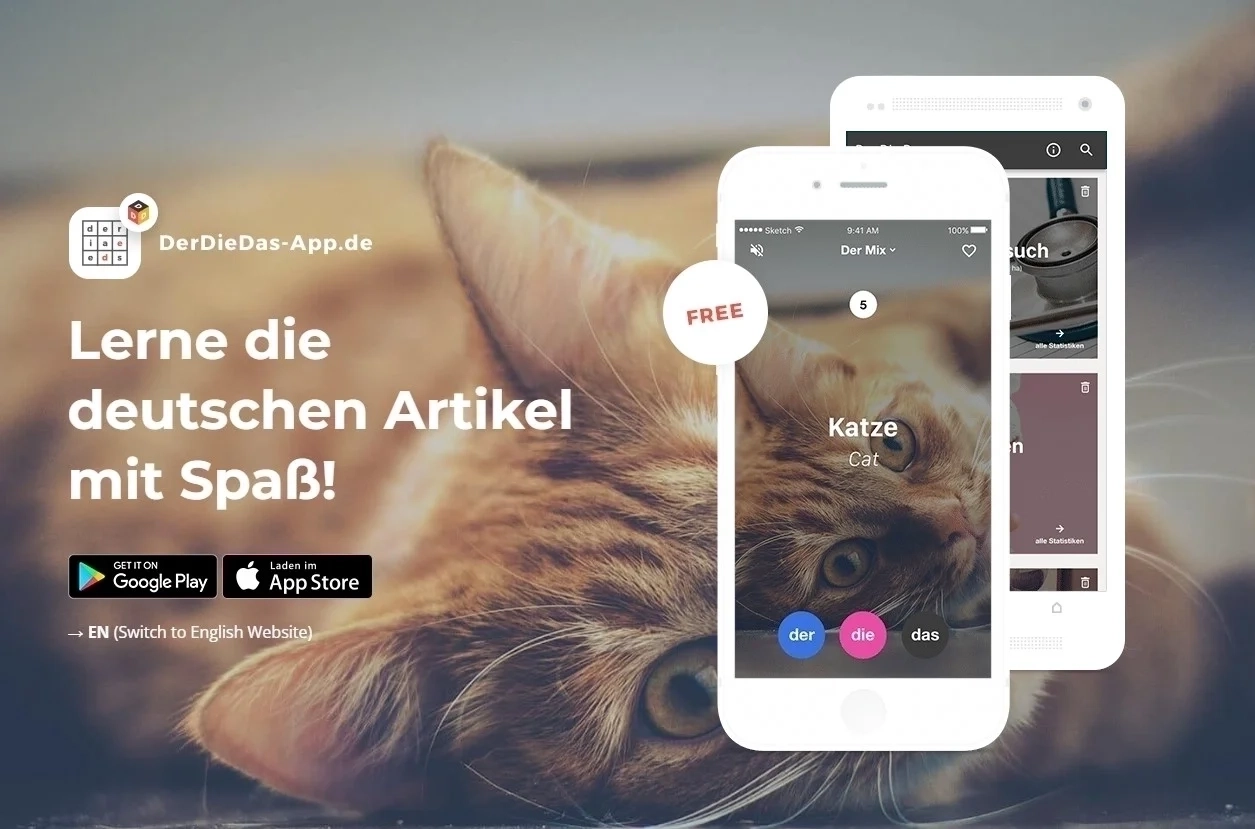
The whole app is built around drilling grammatical gender (Grammatisches Geschlecht) through targeted repetition. What makes it more useful than just flashcards is the search function. You can look up specific words you keep getting wrong and hammer those individually, rather than cycling through thousands of nouns you already know. The interface is clean and completely free of gamification nonsense, which I appreciate more than I expected to. There are no animated streaks, no cartoon owls, no pressure. Just the word, the article, and your answer.
Beyond rote memorisation, the app also explains the actual rules behind article assignment. German does follow patterns here once you know where to look. Suffix rules alone cover an enormous amount of ground. Words ending in -ung, -heit, -keit are always feminine. Words ending in -chen or -lein are always neuter. The Vorsilbe (prefix) rules work similarly. Once those click, you stop guessing on a large chunk of vocabulary.
The limitations are real though. Plural forms are missing entirely, and plural noun forms matter constantly in spoken and written German. There are no translations provided for unfamiliar words either, so if you hit a piece of obscure vocabulary you’ve never seen before, the app gives you no help understanding what it actually means. The free version also serves ads with some regularity, which can break concentration mid-session.
What we like
- Clean, distraction-free interface with zero learning curve
- Search function lets you target your specific problem words
- Explains suffix and prefix rules, not just rote drilling
- Free at the basic level with no mandatory paywall
What we did not like
- No translations provided for unfamiliar or complex vocabulary
- Plural noun forms are entirely absent
- Ads interrupt practice sessions in the free version
Think of Der Die Das as a specialist tool, not a standalone course. General apps like Duolingo barely touch grammatical gender in any systematic way, which leaves a real gap. This app fills it. Use it alongside a broader learning platform and your article accuracy will improve noticeably faster than struggling through random exposure alone.
💰 Pricing
The Der Die Das app is free to use, with an optional paid upgrade to remove advertisements.
Busuu
Busuu was one of the first apps I genuinely stuck with past the two-week mark. What separated it from the rest wasn’t gamification or streak pressure. It was the fact that real native German speakers reviewed my submitted exercises and sent back actual corrections. That kind of human feedback felt like something no algorithm could replace, and for written German especially, it made a real difference.
The app takes a balanced approach across grammar, vocabulary, speaking, and writing rather than leaning too heavily on any single skill. You start with a placement test that takes around ten minutes and gives you a realistic picture of where you actually stand. That matters more than it sounds. Landing in a lesson set that’s either insultingly easy or completely impenetrable is demoralising, and Busuu avoids that problem well. Daily sessions are designed to stay manageable, typically between five and twenty minutes.
Exercise variety is solid without feeling scattered. You get fill-in-the-blank tasks, multiple choice, true or false, and puzzle-style exercises, all built around topics that come up in real conversations rather than the kind of textbook scenarios nobody ever actually uses. The community correction feature, where native speakers review your speaking and writing submissions, is genuinely one of Busuu’s strongest differentiators. Busuu also offers live classes, which pushes it closer to a proper learning ecosystem than a standalone vocabulary trainer.
What we like
- Native German speakers review your speaking and writing submissions directly
- Placement test calibrates your level accurately from day one
- Covers grammar, vocabulary, speaking, and listening in an integrated way
- Multiple exercise formats including puzzles, fill-in-the-blank, and true or false
- Live classes available for structured guided learning
- Clean interface that doesn't overwhelm you with menus or notifications
- Progress tracking shows how your vocabulary is growing over time
What we did not like
- Noticeably fewer games than apps like Duolingo, which some learners find motivating
- Grammar explanations are thinner than dedicated grammar tools
- Some exercises don't explain why your answer was wrong, which slows down learning
- Certain exercises appear without translations, which can frustrate learners at lower levels
Pricing
Busuu is free to download and use, and the placement test is included at no cost. The Premium Plus subscription unlocks offline lesson downloads, a personalised study plan, and full access to all course content. In 2026, Premium Plus costs around €6.66 per month when billed annually, which makes it one of the more affordable paid options on this list. A monthly plan is available at a higher rate for learners who prefer flexibility over commitment. For anyone preparing for the Goethe-Zertifikat or a similar formal language qualification, Busuu Premium Plus also includes official exam preparation content, which adds real value on top of the core course.
Pimsleur
Pimsleur is the one app I genuinely recommend to people who spend a lot of time commuting. It asks nothing of your eyes. No screen, no tapping, no notifications. Just audio prompts that pull you into speaking German out loud, which feels awkward at first but works surprisingly well.
The method is built around spaced repetition through listening and speaking rather than reading. You hear a phrase, you recall it, you produce it. That audio loop trains your ear for real spoken German, which matters a lot when a Freiburger shopkeeper fires a question at you and you need to respond without mentally parsing a written sentence first.
What we like
- Fully audio-based, so it works during commutes, gym sessions, or housework
- Strong pronunciation training through active speaking practice
What we did not like
- It costs around €14.95/month in 2026, which is expensive compared to most apps
- Limited written German practice, so grammar depth stays low
The price is the real sticking point. For passive commute learning it is hard to beat, but at roughly €14.95 per month it should be paired with something free like Deutsche Welle’s Nicos Weg rather than used alone.
What is the best free app to learn German in 2026?
How long does it take to reach B1 German using an app?
Is Duolingo enough to pass the German integration course test?
Which German learning app is best for commuters?
Do I need to learn German to live in Germany?
What German level do I need for a job in Germany?

Jibran Shahid
Hi, I am Jibran, your fellow expat living in Germany since 2014. With over 11 years of personal and professional experience navigating life as a foreigner, I am dedicated to providing well-researched and practical guides to help you settle and thrive in Germany. Whether you are looking for advice on bureaucracy, accommodation, jobs, or cultural integration, I have got you covered with tips and insights tailored specifically for expats. Join me on my journey as I share valuable information to make your life in Germany easier and more enjoyable.