Insurance Brokers vs Insurance Agents in Germany [2026]
In Germany, an insurance broker (Versicherungsmakler) works independently across multiple insurers, while an insurance agent (Versicherungsvertreter) is tied to one company. That single distinction changes everything about the advice you receive. Earlier this year in Wolfsburg, I spent an afternoon trying to sort out better liability coverage and quickly realised I had no idea whether the person sitting across from me was actually shopping the market or quietly selling me their employer’s product. That confusion is more common than people admit.
According to the German Insurance Association (GDV), there were around 46,000 registered insurance brokers in Germany in 2025, yet many expats still approach the wrong type of intermediary and wonder why their options seem oddly limited. The German insurance market is heavily regulated under the Versicherungsvermittlerverordnung (insurance intermediary regulation, governing all licensed intermediaries), which legally separates these two roles. The distinction is rarely explained upfront, though.
This guide breaks down what each type actually does, how their incentives differ, and how to choose a good insurance broker vs going direct in Germany. Whether you need brokerage insurance advice, a health insurance broker, or just want to understand what an insurance agency is legally obligated to offer you, this is the place to start.
Insurance Brokers and Insurance Agents
In Germany, the terms “insurance broker” and “insurance agent” are sometimes used interchangeably in casual conversation, but they describe legally distinct roles with very different obligations to you as a client. Getting this distinction wrong can genuinely cost you money or leave you underinsured. Here is what each one actually does.
Insurance Broker (Versicherungsmakler)
A Versicherungsmakler (independent insurance broker) works for you, not for any insurer. Their legal obligation under § 59 VVG (Versicherungsvertragsgesetz, the German Insurance Contract Act) is to find the most suitable policy available on the open market based on your individual needs. They are not tied to any single insurance company, which means they can compare products across dozens of providers. According to BaFin (Germany’s Federal Financial Supervisory Authority), all insurance brokers operating in Germany must be registered and licensed, and as of 2026 there are approximately 46,000 licensed Versicherungsmakler active in the country.
Their compensation typically comes as a Courtage (broker commission paid by the insurer upon policy placement), a commission paid by the insurer once a policy is sold. Some brokers also charge a direct advisory fee, particularly for complex products like private health insurance (private Krankenversicherung, the premium-based alternative to statutory cover). Because they cannot bind coverage themselves, they pass the finalised paperwork to the insurer to complete the transaction. Think of them as your advocate inside the German insurance market.
Insurance Agent (Versicherungsvertreter)
A Versicherungsvertreter (insurance agent) represents one or more specific insurance companies. They are either tied exclusively to one insurer (a gebundener Vertreter, or captive agent) or they work across a limited panel of insurers as a Mehrfachagent (multi-tied agent). Either way, their primary contractual obligation runs to the insurer, not to you. They help you find the right coverage within the products their company or panel offers, which is perfectly fine as long as you understand that limitation upfront.
Agents typically earn a commission on each policy sold and may also receive performance bonuses from their insurer. For standard products like Haftpflichtversicherung (personal liability insurance) or Kfz-Versicherung (car insurance), an agent from a reputable insurer can get you sorted efficiently and cheaply. For more complex or high-stakes decisions, like choosing between statutory and private health insurance, that narrower product range becomes a real constraint.
Choosing between a broker and an agent really comes down to complexity. For everyday policies, an agent works fine. For decisions involving health insurance, Berufsunfähigkeitsversicherung (occupational disability insurance, which replaces income if you can no longer work in your profession), or any multi-policy setup, a Versicherungsmakler with no insurer ties is usually the smarter call.
Insurance Broker vs Insurance Agent
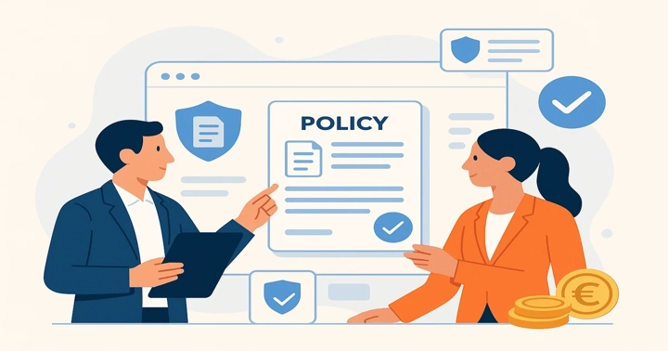
What is the practical difference between an insurance broker and an insurance agent in Germany? An insurance broker (Versicherungsmakler) is legally obligated to act in your interest and can access the full market, while an insurance agent (Versicherungsvertreter) represents one or more specific insurers and is primarily accountable to them.
Both sit between you and the insurer, but they work for very different parties. The distinction matters more than most expats realise when choosing brokerage insurance or comparing health insurance broker options in Germany.
An insurance agent represents one or more specific insurers. Their job is to sell those insurers’ products. An independent insurance broker, by contrast, is legally obligated to act in your interest and can access the broader market. According to the German Insurance Association (GDV), over 400 licensed insurers operate in Germany as of 2026, which means a broker’s market access is genuinely significant.
| Insurance Broker (Makler) | Insurance Agent (Vertreter) | |
|---|---|---|
| Works for | You (the client) | The insurer(s) |
| Products offered | Whole market | One or select few insurers |
| Legal duty | Act in client’s best interest | Represent their insurer |
| Compensation | Commission or fee | Commission from insurer |
| Best for | Complex needs, brokers health insurance | Simple, single-product needs |
The core rule: if you want someone shopping the market on your behalf, you want a Versicherungsmakler. If you already know which insurer you want, an agent works fine.
How to Choose the Right Insurance Agent or Broker in Germany
How do you choose a good insurance broker or agent in Germany? Start by verifying their registration in the national Vermittlerregister, then match their stated specialisation to your actual coverage needs. This is particularly important if you are an expat navigating health insurance for the first time.
Finding a good insurance professional in Germany is not complicated if you know what to actually look for. The challenge is that the market here is enormous. According to BaFin (Bundesanstalt für Finanzdienstleistungsaufsicht, Germany’s federal financial supervisory authority), there were over 200,000 registered insurance intermediaries in Germany as of 2026. With that many options, a little due diligence goes a long way.
Start with Recommendations from People You Trust
Ask expats in your city, colleagues, or community groups who they use. Personal referrals cut through the noise faster than any Google search. Someone who has already navigated the German insurance system as a foreigner will point you toward professionals who actually understand expat-specific situations, like switching between public and private Krankenversicherung (statutory or private health insurance) when your income changes.
Verify Their Registration
Any legitimate insurance broker (Versicherungsmakler) or agent (Versicherungsvertreter) in Germany must be registered in the Vermittlerregister (the national intermediary register), maintained by the Deutschen Industrie- und Handelskammertag (DIHK, the Association of German Chambers of Commerce and Industry). You can check this online for free. Do not skip this step. An unregistered intermediary has no legal obligation to act in your interest.
Check Reviews, But Read Them Critically
Google reviews and independent platforms like Trustpilot give you a rough signal. What you want to see is how the broker handles complaints, not just whether they have five stars. A broker who responds professionally to a negative review tells you more than fifty generic five-star ratings.
Match Their Expertise to Your Needs
A broker strong in health insurance brokerage may know far less about liability or Hausrat (household contents) cover. Ask directly what types of policies they handle most and whether they have experience with non-German clients. The right agent or broker narrows your options intelligently. The wrong one just sells you whatever pays the highest commission.
In Germany, an insurance broker (Versicherungsmakler) works independently across multiple insurers, while an insurance agent (Versicherungsvertreter) represents one company. That single distinction shapes every recommendation they give you. When I was sorting out my coverage in Wolfsburg in 2025, getting that difference straight saved me from signing a policy that looked competitive on paper but came from a single provider with no real alternatives behind it.
The agent and broker distinction matters especially for health insurance. A health insurance broker can compare plans across several statutory and private Krankenversicherung providers, whereas a tied agent will only ever show you their employer’s products. According to GKV-Spitzenverband (the umbrella organisation for Germany’s statutory health insurers) data for 2026, there are over 96 gesetzliche Krankenversicherung (statutory health insurance) providers still operating in Germany, so having someone who can actually navigate that market is worth something.
In fact, according to GKV-Spitzenverband, statutory health insurance (gesetzliche Krankenversicherung) covers approximately 90% of the German population — making it the dominant system and the one most expats enter first.
Choosing between brokerage insurance advice and going direct also has cost implications. Brokers in Germany earn commission from insurers, not from you directly, but that structure affects which products they push. Understanding how each type gets paid is the clearest way to decide who to trust with your coverage.
Who Is the Best Insurance Broker in Germany?
Finding the right insurance broker (Versicherungsmakler) in Germany takes a bit of research, but the good news is you have several reliable ways to go about it. Most expats discover brokers through Google searches, Facebook expat groups, price comparison platforms like Check24, or word-of-mouth from colleagues. That last one is still underrated. A personal referral from someone who has actually filed a claim through a broker tells you far more than any marketing page.
That said, one broker that consistently stands out for English-speaking expats is Neodirect. They operate as an independent Versicherungsmakler, which means they are legally obligated to act in your interest rather than push products from a single Versicherungsgesellschaft (insurance company). According to the GDV (German Insurance Association), independent brokers in Germany have access to products from over 200 licensed insurers as of 2026, which gives them genuine leverage when negotiating on your behalf.
What makes Neodirect worth recommending specifically is their transparency. They provide free, non-binding Optimierungsvorschläge (optimisation proposals, written assessments of where your current coverage is competitive and where it is not) that lay out exactly what you are paying for and where you might be overpaying. They also consolidate all your contracts into their Neo Simplr mobile app, which is genuinely useful when you have Haftpflichtversicherung (personal liability insurance), Hausratversicherung (contents insurance, covering your belongings inside your home), and health coverage scattered across different providers.
Their product range covers the core policies most expats in Germany need: health insurance (both private and statutory supplement plans), liability, household contents, auto, life, and occupational disability. For brokers health insurance questions specifically, they can compare both gesetzliche Krankenversicherung (statutory health insurance) and private Krankenversicherung options side by side.
There is no fee for the evaluation. Neodirect earns through standard broker commissions paid by the insurer, which is the regulated model under § 34d GewO (Gewerbeordnung, the German Trade Regulation Act governing insurance intermediaries). You pay nothing extra for using them versus going direct.
Why You Need the Simplr App
If you’ve spent any time trying to juggle multiple insurance contracts in Germany, you already know the problem. Your Krankenversicherung (statutory or private health insurance) documents are in one email folder, your Haftpflichtversicherung (personal liability insurance) papers are in a drawer somewhere, and your Kfz-Versicherung (car insurance) renewal reminder arrived while you were busy with something else. Simplr is built specifically for this situation.
The Simplr app gives you one centralized platform where every insurance contract you hold is visible at a glance. That matters more than it sounds. When something goes wrong, the last thing you want is to be hunting through old emails to find your policy number. Everything lives in one place, accessible from your smartphone, tablet, or laptop.
What sets Simplr apart from generic document storage apps is that it’s designed around the German insurance market specifically. It includes comparison tools that let you benchmark your existing policies against current market options. According to BaFin (Bundesanstalt für Finanzdienstleistungsaufsicht, Germany’s federal financial supervisory authority), there were over 430 licensed insurers active in Germany as of 2025, which means having an automated way to check whether your contracts are still competitive saves real money.
The app also functions as a kind of lightweight insurance broker Germany tool. It can flag contract improvements and suggest optimizations based on your actual life situation. Changed your address? Got married? Switched jobs? These are all events that should trigger a review of your coverage, and Simplr prompts you to update accordingly rather than leaving you with a policy that no longer fits your circumstances.
One practical feature worth knowing about is the digital signature capability. You can sign new or updated contracts directly inside the app, which eliminates the back-and-forth of printing, signing, scanning, and emailing that still somehow exists in Germany in 2026. You can also upload missing documents by photographing them with your phone, which speeds up any claims or contract completions considerably.
Unlike fully automated comparison platforms, Simplr keeps a human element in the loop. You get a dedicated contact person for advice rather than a chatbot. That’s not a small thing. When you’re dealing with something like brokers health insurance questions or trying to understand the difference between gesetzliche and private Krankenversicherung, a real person who knows your contract history is far more useful than an FAQ page.
Data security follows German standards. All data is encrypted during transmission, and the platform operates under DSGVO (Datenschutz-Grundverordnung, the German implementation of GDPR, which governs how personal data is stored and processed) compliance requirements.
How to Register on Simplr
Signing up takes about two minutes.
Step 1: Go to the Simplr registration page and fill in your desired username, first name, last name, and phone number. Then press “Jetzt registrieren.”
Step 2: After submitting, you’ll be redirected to a confirmation screen with links to download the app on iOS or Android.
Step 3: Once you download and log in, you’ll be guided through connecting your existing insurance contracts. The process is in German, but it’s straightforward even if your German is still at the intermediate level.
Final Thoughts
The difference between an insurance agent and a broker in Germany is not just technical. It shapes who is actually working in your interest when a claim gets complicated or a renewal price creeps up.
My honest take after years of navigating German insurance: most expats are better served by an independent insurance broker (Versicherungsmakler) rather than a tied agent (Versicherungsvertreter), especially for health insurance. According to GKV-Spitzenverband data from 2026, statutory health insurance contributions have risen again, which makes independent comparison more valuable than ever. A Versicherungsmakler is legally obligated under § 63 VVG (Versicherungsvertragsgesetz, the German Insurance Contract Act) to act in your interest. That legal duty matters.
In practical terms: in Germany, only a licensed Versicherungsmakler carries a statutory duty of care toward the client. A Versicherungsvertreter does not.
That said, going direct works fine for straightforward products where price is the only variable. Know what you are buying before you decide who to buy it through.

Jibran Shahid
Hi, I am Jibran, your fellow expat living in Germany since 2014. With over 10 years of personal and professional experience navigating life as a foreigner, I am dedicated to providing well-researched and practical guides to help you settle and thrive in Germany. Whether you are looking for advice on bureaucracy, accommodation, jobs, or cultural integration, I have got you covered with tips and insights tailored specifically for expats. Join me on my journey as I share valuable information to make your life in Germany easier and more enjoyable.