Writing Resignation letter in Germany – Incl. EN & DE Template [2026]
Your resignation letter in Germany needs just 3 things to be legally valid. Get free EN & DE templates and avoid the most common mistakes expats make.
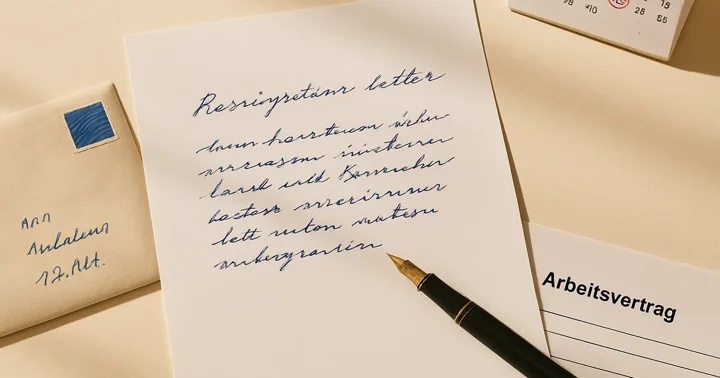
In Germany, a resignation letter (Kündigungsschreiben) must be submitted in writing to make your resignation legally valid. Verbal resignations carry no legal weight under German employment law. That single fact catches a lot of expats completely off guard, especially those arriving from countries where a conversation with HR is enough to call it done.
I learned this properly back in 2019 in Freiburg, when a colleague handed in a typed, signed letter and explained to me that without it, you simply haven’t resigned in the eyes of German law. It was one of those small but genuinely important things nobody tells you when you first start working here.
German employment contracts are governed by the Bürgerliches Gesetzbuch (BGB), the German Civil Code, which sets out specific rules around notice periods, written form, and how a Kündigungsschreiben must be delivered. Get any of these wrong and your resignation may not take effect on the date you intended. According to the Bundesagentur für Arbeit (Federal Employment Agency), the statutory minimum notice period for employees in Germany is four weeks, though your individual contract may extend this significantly depending on how long you’ve been employed.
This guide covers everything you need to write a proper German resignation letter, from the required legal elements and notice period calculations to ready-to-use templates in both German and English. Whether you’re writing a formal Kündigung for the first time or just want to double-check you haven’t missed anything, you’re in the right place.

Importance of a Resignation Letter in Germany
A resignation letter in Germany is not just a formality. It is a legally significant document that formally ends your employment relationship, and without one, your Kündigung (resignation) may not even be valid under German labor law.
German employment contracts almost always require written notice, and a verbal resignation carries no legal weight. Submitting a proper letter starts the official clock on your Kündigungsfrist (notice period), during which your employer can begin recruiting a replacement without disrupting operations. According to the German Civil Code (§ 623 BGB), the written form requirement for resignations is mandatory. There are no exceptions whatsoever.
Beyond the legal side, how you resign genuinely matters for your professional reputation here. Future employers in Germany often request a copy of your Arbeitszeugnis (employment reference letter), and a poorly handled exit can influence what your former employer writes in it. A respectful, well-worded resignation letter signals professionalism and leaves the relationship intact.
What we like
- Legally protects you by triggering the official notice period under § 623 BGB
- Preserves your professional relationship with your employer
- Supports a positive Arbeitszeugnis (employment reference), which future employers in Germany routinely check
- Creates a paper trail if any dispute arises over your last working day or final salary
What we did not like
- A poorly worded letter can damage your reference and professional reputation
- Getting the notice period calculation wrong may result in legal or financial consequences
- Requires written German in most workplaces, which can be challenging for expats
Basic Elements of a Resignation Letter
A proper German resignation letter (Kündigungsschreiben) needs to include several specific elements to be legally valid and professionally sound. Miss any of the core ones and your letter could be disputed or, worse, deemed invalid by your employer.
Your full contact details go at the top, followed by the date and your employer’s address. The date matters more than people realize because it establishes when your notice period officially begins. Below that comes a formal salutation, then the body of the letter itself.
The body should state clearly that you are resigning, name your last working day based on your Kündigungsfrist (contractual notice period), and optionally include a brief, neutral reason for leaving. You are not legally required to explain why you are leaving in Germany, and many people choose not to. A request for a Arbeitszeugnis (employment reference letter) is worth including here too, since employers in Germany are obligated to provide one upon request under § 109 GewO (the German Trade, Commerce and Industry Regulation Act).
Close with a professional sign-off and your handwritten signature. If you are submitting a digital copy, a scanned signature is acceptable, but the original written letter should still be sent by post or handed over in person.
How To Write a Formal German Resignation Letter
Writing a formal German resignation letter is more straightforward than it sounds, but the rules are strict and non-negotiable. Germany requires your resignation to be submitted in writing (Schriftform) on paper, with a handwritten signature. Verbal resignations, emails, and WhatsApp messages carry no legal weight under German employment law. Your termination simply will not count without a physically signed document.
You do not need to explain why you are leaving. German law does not require you to state your reasons in a standard resignation. The exception is if you are resigning without notice (fristlose Kündigung), where providing grounds becomes practically important. For most situations, keep it short and factual. State that you are resigning, specify your last working day based on your notice period (Kündigungsfrist), and request written confirmation from your employer. That confirmation is not legally required from their side, but it protects you if a dispute ever arises over the termination date.
The language of your letter should match the working language of the company. In most German workplaces that means German, though international firms sometimes accept English. When in doubt, German is always the safer choice.
Structure matters more than length here. A valid German resignation letter (Kündigungsschreiben) needs your name and address, the employer’s address, the date, a clear statement of resignation with your intended last day, and your handwritten signature. That is genuinely everything required. Padding it with apologies or lengthy explanations weakens the tone and adds nothing legally.
What Not to Include in the Resignation Letter
A German resignation letter should be short, clean, and legally functional. That’s it. You are not writing a performance review, a grievance report, or a career diary entry.
The most common mistake people make is explaining why they are leaving. You have no legal obligation to give a reason in Germany, and including one only creates complications. Your new employer, your salary offer, your commute frustrations — none of it belongs in this document. Same goes for future plans. Mentioning a competing employer can even trigger early release from your notice period, which may or may not be what you want.
Never use the Kündigungsschreiben (formal resignation letter) to air complaints about colleagues, management, or working conditions. Even if every word is true, it weakens your position and can affect your Arbeitszeugnis (employment reference letter), which German employers take seriously.
Keep it to one page. One page is already longer than most German resignations need to be. Proofread it once before you sign, because a letter with spelling errors in a professional context looks careless regardless of the content.
The letter ends your employment contract. Let it do exactly that, nothing more.
Considerations While Writing Your Resignation Letter
Getting the content right is only half the battle. The format and structure of a German resignation letter matter just as much, and there are a few specific elements that German employers expect to see. Miss one and your letter might still be legally valid, but it will look amateurish at best and create unnecessary back-and-forth at worst.
Your Personal Details
Your name, address, and contact information go at the top of the letter. Whether you place these on the left or right side is purely a matter of preference. Both are acceptable in Germany. What matters is that the information is complete and accurate.
Include your employee number (Personalnummer) if your employer has assigned one. This is especially useful in larger companies where multiple employees might share the same name. It removes any ambiguity about who is resigning and ensures your letter gets routed to the right HR file immediately.
Your active email address, phone number, and postal address should all be there. This is not just a formality. After you leave, your former employer may need to send you documents like your Arbeitszeugnis (employment reference certificate), your final payslip, or pension contribution records. If your contact details are missing or outdated, getting those documents to you becomes someone else’s problem. They might just stop trying.
The date on your letter serves as an official record of submission. Under German employment law (§ 623 BGB), a resignation must be in written form to be legally valid, and the date establishes exactly when that written notice was given. Do not leave it blank or approximate it.
Recipient and Company Information
The company’s details should be left-aligned below your own. If you are sending a physical letter in a window envelope, the recipient block needs to be positioned so it shows through the envelope window. This is the standard German business letter format (DIN 5008).
Write the full legal name of the company, the name of the specific contact person (usually your direct manager or HR representative), the company’s street address, and the postal code with city. Getting this right signals that you understand German professional correspondence norms, which matters more than you might think.
The Subject Line
German business letters always include a subject line (Betreff), and your resignation letter is no exception. The subject line should be direct and include the word “Kündigung” (termination/resignation). You can keep it simple or add your employment contract end date if you have already calculated it precisely.
Common subject line formats:
In German: Kündigung meines Arbeitsvertrages zum DD.MM.YYYY
In English: Resignation / Termination of my Employment Contract as of DD.MM.YYYY
Only include a specific end date if you are confident in your notice period calculation. If you get the date wrong, it creates confusion. When in doubt, state that you are resigning in compliance with the applicable notice period under your contract, without specifying the exact date.
Requesting Your Arbeitszeugnis
Every employee in Germany has a legal right to receive an Arbeitszeugnis (qualified employment reference certificate) when leaving a job. This right is enshrined in § 109 GewO (Gewerbeordnung, the German Trade Regulation Act). Your resignation letter is the right place to formally request one.
The Arbeitszeugnis is not just a nice-to-have. German employers take it seriously, and future employers will expect to see it. A qualified Arbeitszeugnis (qualifiziertes Arbeitszeugnis) covers both the duration of your employment and an assessment of your performance and conduct. A simple Arbeitszeugnis (einfaches Arbeitszeugnis) only confirms the facts of your employment without any evaluation. Always request the qualified version.
Request it explicitly in writing, within the letter itself. Something straightforward like “Ich bitte um die Ausstellung eines qualifizierten Arbeitszeugnisses” (I request the issuance of a qualified employment reference certificate) is sufficient. German labor courts have consistently held that employers must issue this document in a timely manner, and having your written request on record protects you if there is any delay.
Tone and Closing
Keep the letter professional and neutral. You do not need to explain your reasons for leaving, and in most cases it is better not to. Express that you are available to support a smooth handover if that feels appropriate in your situation. A brief, polite closing is enough.
Does a resignation letter in Germany need to include a reason for leaving?
What is a Personalnummer and where do I find it?
Deadlines for Submitting Your Resignation Letter in Germany
In Germany, a resignation letter must be received by your employer either by the 15th of the month or by the last day of the month — those are the only two valid cutoff points. This is one of those rules that trips up a lot of expats because it is stricter than what many people are used to.
The timing works backward from your intended last day. Say your notice period ends on 30 September. Your employer needs to physically receive your Kündigungsschreiben (written resignation letter) at least 28 days before that, which puts the deadline at 2 September. If your final month has 31 days, that deadline shifts to the 3rd of the month. The calculation matters because German law counts calendar days, not working days.
One thing worth being clear about: the letter must arrive by the deadline, not just be sent. Handing it in personally is always the safest approach. Postal delays are your problem, not your employer’s. This is why most people working under a standard German employment contract deliver their resignation by hand and keep a signed copy as proof.
Submission of the Resignation Letter
Delivering your resignation letter correctly matters just as much as writing it properly. In Germany, a resignation letter must be handed over in physical, written form. Email does not count legally. You can submit it in person or send it via registered post (Einschreiben), but the notice period starts running only from the date your employer actually receives it. If you post it on the last valid day, you may find yourself locked into an extra month of work.
Print two copies. Hand one to your direct supervisor or HR department, and ask them to sign and date the second copy as confirmation of receipt. Keep that signed copy somewhere safe. This small step protects you if any dispute arises later about when the letter was received.
If you are posting the letter, always use Einschreiben mit Rückschein through Deutsche Post. That is registered mail with return receipt, and the return slip serves as legal proof of delivery. According to German employment law under § 130 BGB (Bürgerliches Gesetzbuch, the German Civil Code), a written declaration becomes legally effective only once it reaches the recipient. Getting that timing right is genuinely critical.
How to Avoid Disputes with Your Employer?
The cleanest way to leave a job in Germany is to make everything documentable. Send your Kündigung (resignation letter) by registered post (Einschreiben mit Rückschein), keep a signed copy if you hand it over in person, and respect your Kündigungsfrist (notice period) to the letter. Disputes almost always stem from one of these three things being unclear or contested.
That said, workplace conflicts do happen even when you’ve done everything right. This is where Rechtsschutzversicherung (legal expenses insurance) becomes genuinely useful. For around €17 to €25 per month in 2026, a good policy covers legal fees for employment disputes, which can otherwise run into thousands of euros quickly. The Bund der Versicherten, a German insurance consumer association, consistently highlights employment law as one of the most common areas where private individuals need legal representation.
If you think a dispute might be brewing, document everything in writing rather than relying on verbal conversations. German employment law courts (Arbeitsgerichte) deal with these cases frequently, and written evidence carries far more weight than recollections.
Tips for Writing Your Resignation Letter in Germany
Getting the content of your resignation letter right is only half the job. How you handle the practical side can be just as important when it comes to protecting yourself legally. That includes proofreading, copies, delivery, and timing.
Always Proofread Before Submitting
Read your letter at least twice before it leaves your hands. Spelling errors or a wrong date on an official document can cause unnecessary confusion, and in Germany, where precision in paperwork is taken seriously, a small mistake can occasionally raise questions about the intended termination date. Check that the notice period aligns with what your Arbeitsvertrag (employment contract) specifies, that your name and employee number are correct, and that the letter is signed by hand.
Keep Two Signed Copies
Print two physical copies of your letter and sign both by hand. One goes to your employer. The other stays with you as proof that the Kündigung (termination notice) was submitted. This matters more than people realise. If there is ever a dispute about whether or when you resigned, your signed copy is your evidence. A digital file alone is not enough.
Send It the Right Way
Handing your resignation letter directly to your manager or HR department is always the cleanest option. You can ask for a confirmation of receipt on your copy on the spot. If you need to send it by post, use Einschreiben (registered mail with tracking) so that you have a documented delivery date. Under German employment law, your Kündigungsfrist (notice period) begins the day your employer receives the letter. It does not start from the day you wrote it, so the delivery date genuinely matters.
Check Your Notice Period First
Before you write a single word, find the Kündigung section of your employment contract and read it carefully. The statutory minimum notice period in Germany is four weeks, per § 622 BGB (Bürgerliches Gesetzbuch, the German Civil Code), but many contracts specify longer periods, especially after several years of service. Some collective agreements such as TVöD (Tarifvertrag für den öffentlichen Dienst, the collective agreement for public sector employees) have their own rules that may differ from standard contracts.
Dissolving the Contract by Mutual Agreement
If you want to leave before your notice period ends, one option is an Aufhebungsvertrag (mutually agreed contract dissolution). This requires your employer’s written consent and is negotiated rather than unilateral. It can be useful when both sides want a clean, early exit, but get it reviewed by a lawyer or your Gewerkschaft (trade union) first. Signing one without advice can affect your Arbeitslosengeld (unemployment benefit) entitlement, as the Bundesagentur für Arbeit (Federal Employment Agency) may impose a Sperrzeit (benefit suspension period) of up to twelve weeks.
Get Legal Advice When Things Are Complicated
If your situation involves a conflict, a severance negotiation, or an unusually complex contract, spend the money on a Fachanwalt für Arbeitsrecht (specialist employment lawyer). Many offer a first consultation for around €190 including VAT, which is a reasonable price for clarity on a decision that affects your income and employment record.
What to Do After Submitting Your Resignation Letter in Germany
Submitting your resignation letter is not the finish line. Your notice period still counts, professionally and legally, so how you behave during those final weeks matters more than most people expect.
Stay engaged with your work. Turn up on time, meet your deadlines, and hand over your responsibilities cleanly. It sounds obvious, but the temptation to mentally clock out the moment you’ve handed over that signed letter is real. German workplaces tend to be small worlds, and your Arbeitszeugnis (work reference certificate) is written during or after this period. A lukewarm Zeugnis can follow you into your next application in ways that are genuinely painful.
There is also a practical reason to stay professional: German employers sometimes contact each other informally, and your new employer may ask questions before your start date. That kind of reputation is hard to undo once it’s set.
Use the notice period to document your ongoing tasks, brief whoever is taking over your responsibilities, and tie up any loose ends with clients or colleagues. Return company property before your last day. Check whether you are owed any remaining Urlaubsabgeltung (compensation for unused annual leave), which your employer is legally required to pay out upon termination under § 7 BUrlG.
Wrapping Up
Getting your resignation right in Germany is not just about being polite. It protects your legal rights, your notice period, and the reference letter (Arbeitszeugnis) your future employer will almost certainly ask for. A signed, written Kündigung sent by registered post (Einschreiben) is the baseline requirement. Everything else, the tone, the formatting, the final sentence, shapes how you exit.
My honest final tip: keep the letter short and neutral. German employers are not expecting a heartfelt farewell. They want a document that is legally valid and professionally worded. One page, two paragraphs, a handwritten signature. That is genuinely all it takes.
How do I write a resignation letter in Germany?
Does a resignation letter in Germany need to be in German?
What is the standard notice period for resignation in Germany?
Can I resign by email in Germany?
Do I need to give a reason for resigning in Germany?
Where do I send my resignation letter in Germany?

Jibran Shahid
Hi, I am Jibran, your fellow expat living in Germany since 2014. With over 11 years of personal and professional experience navigating life as a foreigner, I am dedicated to providing well-researched and practical guides to help you settle and thrive in Germany. Whether you are looking for advice on bureaucracy, accommodation, jobs, or cultural integration, I have got you covered with tips and insights tailored specifically for expats. Join me on my journey as I share valuable information to make your life in Germany easier and more enjoyable.