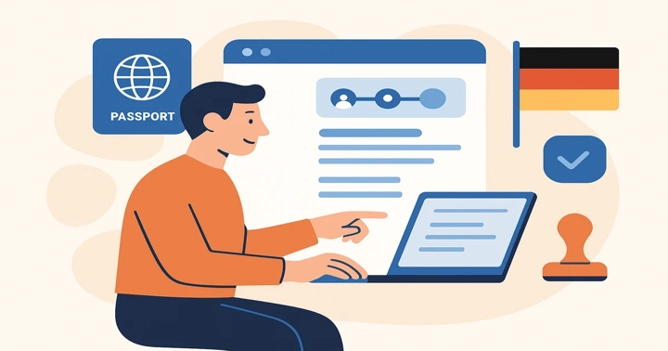
City Registration (Anmeldung) in Germany [ 2026 ] - Live In Germany
City registration in Germany, known as the Anmeldung (official address registration with your local authority), is legally required within 14 days of moving into any new residence. Miss that deadline and you can face a fine of up to €1,000, though the authorities tend to be more forgiving with people who are genuinely new to the country and clearly trying.
When I moved to a new flat in Wolfsburg in 2023, the Anmeldung was the very first thing I sorted out, even before unpacking properly. Without the Anmeldebescheinigung (the registration confirmation certificate you receive), almost nothing else falls into place. Your bank account, your health insurance, and your tax ID all stall without that one small piece of paper.
According to Destatis, Germany had over 84.7 million registered residents as of 2024, and every single one of them went through this same process. That figure reflects how seriously Germany takes its Einwohnermelderecht, the legal framework that governs resident registration across all 16 federal states. The Anmeldung is processed at your local Bürgeramt (citizens’ office) or Rathaus (town hall), and the experience varies quite a bit depending on where you live. In Berlin or Munich, you might wait weeks for an appointment. In a smaller city like Wolfsburg, you can often walk in the same week. This guide covers the full process, what documents you need, how to handle it in major cities, and what to do if things go wrong.
What is Anmeldung (City Registration) in Germany?
Anmeldung is Germany’s mandatory address registration system, and the short version is this: if you live in Germany, you are legally required to register your residential address with your local municipal authority. There are no exceptions. German citizens, EU nationals, and non-EU expats all go through the same process at the same office, the Einwohnermeldeamt or Bürgeramt (local residents’ registration office).
The word Anmeldung literally means “registration,” and in everyday expat life it refers specifically to this address registration with city authorities. Once you complete it, you receive a document called the Meldebescheinigung (official proof of residence). That single piece of paper is what unlocks nearly everything else you need to actually function here. Opening a bank account, applying for your Steuer-ID (tax identification number), sorting out Krankenversicherung (statutory health insurance), signing a phone contract — all of it requires your Meldebescheinigung first.
The legal basis sits in the Bundesmeldegesetz (Germany’s Federal Registration Act), which standardises registration requirements across all 16 federal states. According to Destatis, Germany recorded approximately 84.7 million registered residents as of 2024, with municipal registration data forming the official backbone of population statistics. Authorities use your registered address for tax correspondence, electoral rolls, and any official contact from agencies like the Ausländerbehörde (foreigners’ registration office). If your address isn’t registered, none of those letters reach you, and that creates problems quickly.
You are required to complete your Anmeldung within 14 days of moving into a permanent residence. The 14-day window is the national standard under the Bundesmeldegesetz, though some municipalities have slightly different local rules. Missing the deadline does not automatically result in a fine, but it can. Enforcement is inconsistent across cities, and most people who are a few days late face no consequences. That said, there is no good reason to delay it.
What we like
- Your Meldebescheinigung immediately unlocks bank accounts, your Steuer-ID, health insurance enrollment, and most other official processes
- Registration is completely free of charge at every Bürgeramt across Germany
- Once registered, your address is officially recognised for all government correspondence, which means you will not miss critical letters from the Finanzamt or Ausländerbehörde
- For non-EU nationals on a visa, completing Anmeldung quickly gives you formal legal clarity on your residence that employers and landlords expect to see
What we did not like
- You cannot register without a permanent address, which creates a genuine chicken-and-egg problem if you arrive and spend your first weeks in a hotel or short-term rental
- Appointment availability at the Bürgeramt varies wildly by city. In larger cities like Berlin or Munich, waiting several weeks for a slot is common
- Landlords must provide a Wohnungsgeberbestätigung (landlord confirmation form) for you to register. If your landlord is uncooperative or slow, your entire timeline gets delayed
Who Needs City Registration in Germany?
The short answer is everyone. German law requires anyone taking up permanent or even semi-permanent residence in Germany to complete the Anmeldung (city registration), regardless of nationality. German citizens moving between cities, EU nationals settling for work, non-EU expats on visas, international students, and even refugees going through the asylum process all have the same obligation. Nobody gets a pass.
The legal basis comes from the Bundesmeldegesetz (Federal Registration Act), which came into force in 2015 and unified registration rules across all sixteen German states. Before that, each state ran its own system, which caused genuine confusion for anyone moving around the country. The current rules are clear and uniform: you register where you actually live, and you must do so within fourteen days of moving in.
What surprises many newcomers is how quickly this obligation kicks in. Under the Bundesmeldegesetz, anyone living at an address for more than three months must register. Some cities apply this even more strictly in practice. If you are renting a furnished flat for a four-month internship in Frankfurt or Hamburg, you still need to register in that city. Short-term does not mean exempt.
The Anmeldung also matters well beyond legal compliance. Without it, you genuinely cannot function in Germany in any practical sense. Banks require proof of registration before opening an account. Mobile phone providers ask for it on contract plans. Your employer needs your registered address to sort out payroll and tax class. Many newcomers find themselves stuck in a frustrating loop: you need a bank account to pay rent, you need a registered address to open a bank account, and you need the Anmeldung to confirm that address. Getting the registration done first is the only way to break that cycle.
Germany also distinguishes between a Hauptwohnsitz (primary residence) and a Nebenwohnsitz (secondary residence). If you maintain two homes, say a flat in Düsseldorf where you work during the week and a family home in another city, you register both addresses. The Hauptwohnsitz is generally where you spend the majority of your time, and it determines things like which Finanzamt (tax office) handles your returns and which local services you are entitled to use. Registering a secondary residence often comes with an additional local tax, so it is worth being aware of that cost upfront.
According to the Statistisches Bundesamt (Destatis), Germany had approximately 84.7 million registered residents as of 2026, a figure that only exists because registration is genuinely enforced. This is not a bureaucratic formality that people quietly skip. Landlords are legally required to confirm your move-in with a document called the Wohnungsgeberbestätigung. It is a landlord confirmation form that you need to bring to the registration appointment. Without it, the Bürgeramt (local registration office) will not process your Anmeldung.
How to Do Anmeldung in Germany
The actual process is simpler than the bureaucratic reputation suggests. You book an appointment at your local Bürgeramt (citizens’ office, the front-line authority handling registrations), show up with your documents, and a civil servant fills in the registration form alongside you. The whole thing takes around fifteen minutes once you’re sitting at the desk.
Before your appointment, download and complete the Anmeldeformular (the official registration form) in advance. Most cities make this available on their municipal website. Walking in with a pre-filled form genuinely speeds things up, and the officer at the desk will appreciate not having to prompt you for every field. It’s a small thing, but it signals that you’ve done your homework.
Once your registration is processed, the office issues you a Meldebescheinigung (official proof of address registration) on the spot. This document unlocks a surprising amount immediately. You can use it to open a German bank account, sign a mobile phone contract, and confirm your address to an employer while your residence permit is still being processed. The Meldebescheinigung is one of those documents you’ll end up making several copies of in the first few weeks.
A few weeks after your Anmeldung, letters start arriving. The Bundeszentralamt für Steuern (Federal Central Tax Office) automatically assigns every registered person in Germany a Steueridentifikationsnummer (tax identification number, an 11-digit number used for all tax matters), and that arrives by post within two to four weeks. Shortly after, you’ll receive your Sozialversicherungsausweis (social security card issued by Deutsche Rentenversicherung). Then, almost predictably, comes the letter from the Beitragsservice asking you to register for the Rundfunkbeitrag (public broadcasting fee), which currently stands at €18.36 per month per household in 2026.
If your employer needs your Steuer-ID before it arrives by post, you don’t have to sit and wait. Visit your local Finanzamt (regional tax office) in person with your passport and Meldebescheinigung, and they can retrieve it on the spot. The tax ID already exists in the Bundeszentralamt für Steuern’s system the moment your registration is processed, so you’re not asking them to create anything new. To find your nearest Finanzamt, enter your postcode directly on the Bundeszentralamt für Steuern website at bzst.de, or search “Finanzamt” followed by your city name.
Germany requires all residents, including EU citizens, to register their address at the local Bürgeramt within 14 days of moving in. Missing that window doesn’t trigger automatic penalties in most cases, but it creates complications the moment you need a bank account, a SIM card, or any formal contract.
Tax Reduction and Your Steuer-ID
Without a Steuer-ID (Tax Identification Number) on file with your employer, Germany’s payroll system defaults to the harshest possible deduction rate. Your employer is legally required to tax you under Steuerklasse VI (Tax Class 6), which applies a withholding rate of 42% on your gross salary. That is not an error. Nearly half your earnings vanish before you ever see them.
The fix is straightforward, but the timing matters. Your Steuer-ID is issued automatically after you complete your Anmeldung (city registration). You do not apply for it separately. The Bundeszentralamt für Steuern (Federal Central Tax Office) mails it to your registered address, typically within two to four weeks of registration. The moment it arrives, hand it to your HR department or employer. Do not wait until the next payroll cycle.
If you start a job before your Steuer-ID arrives, your Nettolohn (take-home pay after income tax and social contributions) will look catastrophically wrong on your first payslip. You will eventually reclaim the over-deducted amount through your annual Steuererklärung (tax return), but that process takes months. Budgeting through your first weeks in Germany on a fraction of your actual earnings is a situation worth avoiding entirely.
One distinction worth understanding early: your Steuer-ID is an 11-digit number that stays with you permanently, regardless of how many times you move cities or change employers. Your Steuernummer (tax number), by contrast, is assigned by your local Finanzamt (tax office) and can change each time you relocate to a new city. The Steuer-ID is the permanent identifier. The Steuernummer is the local one.
According to the Bundeszentralamt für Steuern, every person registered in Germany receives a Steuer-ID, and as of 2026 the system is directly integrated with the national registration database. Your Anmeldung triggers the issuance automatically. There is no separate form to submit, no fee, and no appointment required.
If four weeks pass and the letter still has not arrived, you can request your number through the official BZSt online portal. You will need your date of birth and the address you registered under. The number is sent by post again, so build in extra time if you are approaching a payroll deadline.
One quotable fact worth holding onto: in Germany, your Steuer-ID is issued for life and does not change even if you leave the country and return years later. It is linked to you as a person, not to your address or employment.
City Registration in Germany in Just a Few Easy Steps
Getting your Anmeldung (official address registration at the local Bürgeramt, or citizen registration office) done is far less painful than the horror stories suggest. With the right documents prepared in advance, the appointment itself is typically over in fifteen to twenty minutes. The waiting room beforehand can stretch that considerably, but the actual desk time is nothing to fear.
Here is how the process works in practice.
Step 1: Book an Appointment at Your Local Bürgeramt
Your first task is locating and booking a slot at the nearest Bürgeramt. In smaller towns, registrations are sometimes handled at the Rathaus (town hall) instead, so check your city’s official municipal website to confirm which office handles Meldeangelegenheiten (registration matters) in your area.
Most German cities now offer online booking through their municipal portals. Berlin, Hamburg, and Munich all have dedicated appointment systems that are navigable even with limited German. If you find yourself lost in the terminology, open the page in Google Chrome and use the built-in translation feature. The service categories to look for are Anmeldung, Wohnsitz anmelden, or Ummeldung (if you are changing an existing registered address rather than registering for the first time). Find the right category, then book the earliest available slot.
One genuinely useful trick: many cities release appointment slots in batches, often early in the morning. If the calendar shows nothing available for weeks, check back around 8am the following day. Slots fill up fast, so persistence pays off here.
The Berlin Problem and How to Work Around It
For anyone doing city registration in Berlin specifically, the appointment system is notoriously congested. According to Berlin’s own Senatsverwaltung data, average wait times for Anmeldung appointments remained above two weeks throughout most of 2025 and into 2026. In practice, waits of three to four weeks are common during peak moving periods like September and October.
If you cannot wait that long, there is a legitimate workaround. Berlin’s Bürgerämter do occasionally release same-day cancellation slots through the online portal. These appear without warning, so checking the booking system multiple times a day does actually help. Some expats also have success calling their local Bürgeramt directly first thing in the morning to ask about cancellations. It feels old-fashioned, but it works.
Anmeldung Without an Appointment
Outside of Berlin, many Bürgerämter still accept walk-in registrations without a pre-booked appointment. The approach is straightforward but requires an early start. Arrive at least thirty minutes before the office opens, collect a numbered Warteticket (queuing ticket) from the machine near the entrance, and wait for your number to appear on the display board. This works consistently in mid-sized cities like Düsseldorf, Leipzig, Hannover, and Freiburg, where demand is more manageable than in the major metropolitan centres.
In Berlin, walk-ins without appointments are effectively not possible at most district offices as of 2026. The city’s official guidance directs residents to use the online booking system exclusively.
Step 2: Gather Your Documents Before You Go
Arriving at the Bürgeramt without the correct paperwork means leaving without your Anmeldebestätigung (registration confirmation), so it is worth being thorough. The core documents required are the same across all German cities.
| Document | Details |
|---|---|
| Valid passport or national ID | For EU citizens, a national ID card is sufficient |
| Wohnungsgeberbestätigung | Landlord confirmation form, mandatory since 2015 under § 19 Bundesmeldegesetz |
| Completed Anmeldeformular | Registration form, available on your city’s website or at the office |
| Marriage certificate | Required if registering with a spouse |
| Birth certificates for children | If registering minors at the same address |
The Wohnungsgeberbestätigung (landlord confirmation of residence, sometimes called the Einzugsbestätigung) is the document that trips people up most often. Your landlord is legally required to provide it under § 19 of the Bundesmeldegesetz (Federal Registration Act), but some landlords are slow to issue it. Request it the moment your rental contract is signed.
Step 3: Attend Your Appointment
The appointment itself is brief. A Bürgeramt clerk will review your documents, enter your details into the system, and issue your Anmeldebestätigung on the spot. This confirmation slip is a critical document. You will need it to open a German bank account, register with a health insurer, and set up utilities.
Germany requires all residents, including EU citizens and third-country nationals, to register their address at the local Bürgeramt within 14 days of moving in. This is not optional. Failure to register on time can result in a fine of up to €1,000 under § 54 Bundesmeldegesetz, though in practice, first-time oversights are rarely prosecuted if you register promptly once you have stable accommodation.
According to Destatis, Germany processed over 10 million address registrations and re-registrations in 2024, reflecting the country’s high internal mobility alongside new arrivals. The system is built for volume. Your individual appointment, once you have it, will feel almost anticlimactic after the effort of securing the slot.
Penalties For Delay or No Anmeldung in Germany
The Anmeldung is a legal obligation under the Bundesmeldegesetz (Federal Registration Act), not a polite suggestion. Germany does not run on goodwill when it comes to registration, and the assumption that nobody checks has a way of becoming expensive.
The law gives you 14 days from moving into a permanent address to register. Missing that window does not trigger an automatic fine the next morning, but it does expose you to one. Under § 54 Bundesmeldegesetz, failing to register or registering significantly late without a valid reason can result in a fine of up to 1,000 euros. First-time offenders in minor delay situations rarely see the maximum, but that ceiling is written into federal law, not invented by nervous expat forums.
The most common reason people end up late is a landlord dragging their feet on the Wohnungsgeberbestätigung (the landlord confirmation form required for registration). Without that signed document, you physically cannot complete the Anmeldung regardless of how organised you are. If your landlord is slow, put the request in writing by email immediately. That paper trail can work directly in your favour if the Bürgeramt (local registration office) later questions why you registered outside the 14-day window.
The practical consequences stack up faster than the legal ones. Without your Meldebescheinigung (registration certificate), you cannot open most German bank accounts, cannot register a vehicle, and cannot set up health insurance properly. Some employers flag missing registration as a compliance issue during onboarding. Non-EU nationals face additional risk because late Anmeldung can directly complicate the residence permit process at the Ausländerbehörde (foreigners’ authority). According to BAMF, a valid registered address is a baseline requirement for most residence permit applications and renewals in 2026.
One genuine grey area worth understanding: if you are still searching for permanent accommodation, Germany does make allowances. Staying temporarily with friends, in short-term rentals, or passing through a hostel does not trigger the registration obligation the same way, because none of those constitute your primary fixed residence. The 14-day clock starts the moment you sign a lease or move into a place you intend to stay. That distinction is legally meaningful and prevents a lot of unnecessary panic during the apartment-hunting phase.
If you do find yourself registering late, showing up to the Bürgeramt with documentation of why (emails to your landlord, a temporary accommodation contract, anything dated) is far better than showing up empty-handed. German bureaucracy responds well to paper evidence.
Ummeldung (Change of Residential Address) and Abmeldung (Deregistration) in Germany
Moving flats is practically a sport in Germany, and every time you do it, you have a legal obligation to update your registration within fourteen days of moving in. This process is called Ummeldung (re-registration at a new address), and it follows the same steps as your original Anmeldung. You book an appointment at your local Bürgeramt, bring the new Wohnungsgeberbestätigung (landlord confirmation of residence) signed by your new landlord, fill in the registration form, and you are done. The clerk updates your address on the spot and hands you a fresh Meldebestätigung (registration confirmation). Getting that appointment quickly can still be a headache in larger cities, but the process itself is straightforward.
What surprises many people is how seamlessly the address change ripples through other systems. Your employer, your bank, and the Finanzamt (tax office) all eventually receive the updated address through the central Melderegister (residents’ register). That said, relying entirely on the system to notify everyone is not a safe bet. Contacting your bank, health insurer, and employer directly is good practice and avoids any gaps in correspondence reaching you.
Abmeldung: Deregistering Before You Leave Germany
If you are leaving Germany permanently, you need to formally deregister. This is called Abmeldung (deregistration), and unlike the Anmeldung, you can complete it without an appointment at most Bürgerämter across the country. Under the Bundesmeldegesetz (Federal Registration Act), you must file your Abmeldung no earlier than one week before your departure and no later than two weeks after you leave. Most people handle it in the final week before they go.
Skipping the Abmeldung is a genuine mistake that costs people real money. Without it, Germany’s administrative systems continue treating you as a resident. The Rundfunkbeitrag (public broadcasting fee), currently €18.36 per month in 2026, keeps running. If you are registered with a church, Kirchensteuer (church tax) continues being deducted. Your Krankenversicherung (statutory health insurance) may keep billing you as well. Expats who skip this step regularly spend months untangling billing disputes from abroad. It is not worth it.
To complete your Abmeldung, you submit an Abmeldeformular (deregistration form) at your Bürgeramt and present your passport or national ID. You will receive an Abmeldebestätigung (deregistration confirmation) in return. Hold onto that document carefully. You may need it to close a German bank account, cancel insurance contracts, or confirm your departure date to the Finanzamt when settling any final tax obligations. The whole process typically takes under fifteen minutes once you reach the counter.
One practical note: if you are moving to another country within the EU, some German institutions will still want written confirmation of your new foreign address alongside the Abmeldebestätigung. Having a utility bill or official letter from your new country ready can save you a follow-up trip or a round of emails.
Conclusion
City registration in Germany sounds more complicated than it actually is. Once you’ve been through it, the whole process clicks into place fast. The Anmeldung (official address registration) is really the foundation of your administrative life here. Without it, you cannot open a bank account, get a SIM card registered to your name, apply for your Aufenthaltstitel (residence permit), set up internet at home, or enroll in statutory Krankenversicherung (health insurance). Everything else is downstream from this one appointment.
The single most important thing I’d tell any newcomer: do not wait. Germany requires all residents, including EU citizens, to register their address at the local Bürgeramt (citizens’ office) within 14 days of moving into accommodation. Miss that window and you risk a late registration fine, which is genuinely the last thing you need during an already stressful move. Get your Wohnungsgeberbestätigung (landlord confirmation letter) sorted before you even book the appointment. Without it, the Bürgeramt officer cannot process your registration regardless of what else you bring.
The process itself is not difficult. You fill out the Anmeldeformular (registration form), bring your passport or national ID, hand over the Wohnungsgeberbestätigung, and within roughly 15 to 30 minutes you walk out with your Meldebestätigung (registration certificate). That small printout opens most of the doors you need opened.
Berlin deserves a separate mention because it genuinely operates differently from everywhere else. Bürgeramt appointment availability in Berlin can stretch to several weeks, and walking in without a slot is technically possible at some offices but practically unreliable. The most effective tactic is checking the Bürgeramt Berlin online booking portal early in the morning, around 7 or 8 AM, when cancellation slots tend to appear. In smaller cities, including Wolfsburg where I live now, booking a slot is rarely more than a few days’ wait.
According to BAMF (Bundesamt für Migration und Flüchtlinge), registering promptly also directly affects how quickly subsequent immigration steps can be processed, since most residence permit applications require proof of registration as a first step. Delays in Anmeldung create a cascade of delays across everything else.
My honest final tip: treat the Anmeldung like the first domino. Get it done in week one if you possibly can, not week two. Keep two printed copies of your Meldebestätigung once you have it. German institutions ask for it more often than you’d expect, and it costs nothing to be prepared.

Jibran Shahid
Hi, I am Jibran, your fellow expat living in Germany since 2014. With over 11 years of personal and professional experience navigating life as a foreigner, I am dedicated to providing well-researched and practical guides to help you settle and thrive in Germany. Whether you are looking for advice on bureaucracy, accommodation, jobs, or cultural integration, I have got you covered with tips and insights tailored specifically for expats. Join me on my journey as I share valuable information to make your life in Germany easier and more enjoyable.