Visiting Hairdresser (Friseur) in Germany – Must Know Things [2026]
A standard haircut at a German Friseur (hairdresser) costs between €15 and €35 for men and €35 and €80 for women in 2026, depending on the salon, the city, and exactly what you’re asking for. Prices climb noticeably in cities like Munich or Hamburg and ease off a little in smaller towns. According to Destatis, personal care services including hairdressing have seen consistent price increases over the past three years, so what you paid during a previous stay in Germany may no longer reflect what you’ll find at the counter today.
When I first walked into a Friseur in Freiburg back in 2016, I handed over what felt like a simple request and walked out having paid nearly €30 for what I would have called a basic trim back home. That was my introduction to how seriously Germans take their hair appointments.
There’s quite a lot going on behind the scenes at a German hairdresser that most expats miss on the first visit. Appointments are the norm rather than the exception, and walk-ins are genuinely hit or miss depending on the salon and the day. The vocabulary matters more than you’d expect too, because a simple mix-up between “kürzen” (trim) and “schneiden” (cut) can have real consequences for your hair. This guide covers everything you need before you book your first Friseurtermin (hairdresser appointment) in Germany, from what a haircut actually costs across different cities to how to communicate what you want without the awkward guesswork.
Things You Must Know Before Visiting a Hairdresser in Germany
Germany has its own quiet set of unwritten rules around getting a haircut, and almost nobody tells you these upfront. Walk into a Friseur (hair salon) the same way you would back home and you might end up paying more than expected, or stepping outside into cold air with dripping wet hair.
The hair wash question catches most expats off guard first. Nearly every salon will ask whether you want your hair washed before the cut, and this is not bundled into the base price. Saying yes adds a few euros to your bill. It sounds minor, but deciding your answer before you sit down is genuinely useful.
Blow-drying works the same way. In many countries, a blow-dry comes as a matter of course and you pay extra only for a styled blow wave. In Germany, even a basic blow-dry costs extra on top of the cut. This is the actual reason you will often see people leaving a Friseur with visibly damp hair. Most salons keep a hair dryer near the exit that clients can use themselves, free of charge, before heading out into the street.
Clipper lengths are another point of confusion. German barbers measure in millimetres rather than numbered guards. If you are used to asking for a “number two,” that phrase does not translate here. You would ask for 6 mm instead. Showing a photo on your phone is still the most reliable approach regardless, because even if you get the millimetre right, the final result depends heavily on the individual stylist’s interpretation. A clear reference image removes almost all ambiguity.
Language is less of a barrier than many expats expect. According to Statista, there were over 80,000 registered Friseur businesses in Germany as of 2024, and that figure has remained stable into 2026, which means real competition exists and many salons actively welcome international clients. Larger city salons in particular tend to have at least one stylist who can manage a consultation in English.
Appointments, or a Termin (booking slot), are standard practice. Walk-ins are possible at smaller neighbourhood shops, but relying on one is risky, especially on weekends. Booking one to two days ahead is the norm. Many salons now offer online booking tools, which sidesteps the phone call entirely if your German is not quite there yet.
What we like
- Friseur salons are widely available across Germany, even in smaller towns
- Online booking tools at many salons make appointments easy without speaking German
- Salons are well-regulated and trained stylists must complete a formal Berufsausbildung (vocational apprenticeship)
- Photo references on your phone are widely accepted and genuinely understood
What we did not like
- Hair wash and blow-dry are priced separately, so the final bill is often higher than the advertised base price
- Clipper guard numbering differs from UK and US systems, which can cause miscommunication
- Walk-in availability is unreliable, particularly at busier urban salons on weekends
If you are still getting used to how everyday services work in Germany, understanding the broader culture around appointments and tipping helps a lot.
How to Get an Appointment at a Hairdresser in Germany?
Getting an appointment at a German salon (Friseur) is straightforward once you know how it works. Most salons operate by appointment, and while walk-ins are possible at budget chains and barber shops, booking ahead is simply the smarter move if you want a specific stylist or a longer service like colouring or a wash and cut. Showing up unannounced at a quality salon on a Saturday afternoon is a gamble you will almost certainly lose.
The most direct route is calling the salon. You genuinely do not need polished German for this. A simple introduction covers everything: say your name, state what service you need, and ask for a free slot. Something like “Guten Tag, mein Name ist [Name]. Ich würde gerne einen Termin für einen Haarschnitt vereinbaren” (Good day, my name is [Name]. I would like to book an appointment for a haircut) gets the job done. The person on the phone will ask which day works for you, what exactly needs doing, and a number to confirm the booking. That is usually the entire conversation, over in two minutes.
Online booking has become genuinely widespread across Germany. According to a 2026 report by the Zentralverband des Deutschen Friseurhandwerks (Central Association of the German Hairdressing Trade), around 38% of hairdressing businesses now list online appointment booking as their primary scheduling method, a significant shift from pre-pandemic norms. Most mid-range and upscale salons use platforms like Treatwell or their own website calendar. You pick the service, choose a stylist if you have a preference, select a time slot, and confirm with your email address. No German required. This is honestly how I tend to book now, because it removes the phone anxiety that comes with operating in a second language.
What the Salon Will Ask You
When you book, whether by phone or online, expect the salon to confirm four things: the service you want, your preferred date, a suitable time window, and your contact details. For longer or more complex services, some salons will also ask about your hair type or current colour so the stylist can prepare. This is completely routine and nothing to be caught off guard by.
Walk-in barber shops are a different story. They are particularly common in city centres and are often run by Turkish or Arabic-speaking owners. No booking, no call, no app. You sit, you wait, you get your haircut. These shops tend to be faster, cheaper, and far less formal about scheduling.
Timing matters more than most people realise. Tuesday through Thursday typically have the best availability across most salons. Many salons stay closed on Mondays altogether, and Friday afternoon through Saturday is peak time when slots vanish fast. If you need a weekend appointment, booking several days in advance is not excessive.
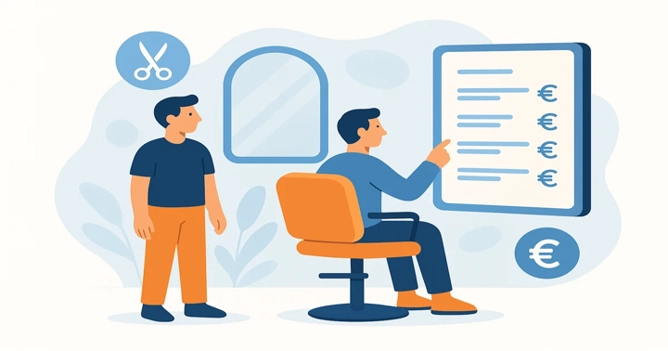
What are the Typical Prices for Haircuts in Germany?
A standard men’s haircut (Herrenhaarschnitt) at a mid-range German salon costs between €18 and €25 in 2026, though where you live shifts that range considerably. According to Destatis, personal care services have seen consistent price increases over the past several years, with urban salons running roughly 20–30% higher than those in smaller towns and rural areas.
For men, budget options exist and they’re genuinely worth knowing about. Turkish barbershops are everywhere in German cities and typically charge €10–€15 for a clean cut. A mid-range salon in a city like Wolfsburg or Freiburg usually sits around €18–€22. Move to Munich or Frankfurt, and the same haircut at a comparable salon can easily reach €25–€35. The question “was kostet ein Herrenhaarschnitt” gets searched constantly by expats trying to calibrate expectations before they walk through the door, so having a rough figure in mind helps you avoid that awkward moment when you see the price list.
Women’s pricing works differently, and the logic isn’t always obvious to newcomers. German salons structure women’s prices around hair length and service complexity rather than a flat rate. A wash, cut, and blow-dry for short to medium-length hair typically runs €35–€55. Longer hair or any additional treatment like colouring or keratin can push the total past €70 in bigger cities. It can feel like the pricing shifts every time, but it’s largely time-based rather than arbitrary.
Children’s haircuts usually land in the €10–€20 range, though some salons charge close to adult prices. The reasoning isn’t unreasonable: a squirming child can take twice as long as a straightforward adult cut, and many Friseure price accordingly. If you’re taking a young child for the first time, it’s worth calling ahead to ask what they charge.
Here’s a quick comparison across service types and city tiers to give you a clearer picture:
| Service | Budget / Small Town | Mid-range (Wolfsburg, Freiburg) | Major City (Munich, Frankfurt) |
|---|---|---|---|
| Men’s haircut | €10–€15 | €18–€22 | €25–€35 |
| Women’s wash, cut, blow-dry | €25–€35 | €38–€55 | €55–€75+ |
| Children’s haircut | €10–€15 | €12–€18 | €15–€22 |
If you want to confirm the haircut price in Germany before you commit to a salon, the simplest approach is to call ahead and ask directly. Most salons are perfectly happy to give you a range over the phone, especially if you describe your hair length and what you want done. Turning up without a clue and hoping for the best works out sometimes, but not always.
How Much Tip is Expected by Friseur in Germany?
Tipping at a German Friseur (hairdresser) is optional, but genuinely common. The norm is roughly 10% of the total bill. If your haircut costs €18, rounding up to €20 is the done thing. For bigger appointments like colouring or highlights where the bill climbs higher, a flat €3 to €5 is completely acceptable. Nobody expects you to do precise maths at the till.
According to Destatis data from 2025, personal care services including Friseurbesuche (hairdresser visits) saw price increases of around 4.2% year-on-year. That matters for tipping because if you always round up by a fixed €1 or €2, that gesture has quietly shrunk in real terms. Sticking to the 10% rule keeps things proportionate as prices continue to climb.
The practical mechanic of tipping in Germany catches a lot of expats off guard. You do not hand over the money and wait for change. Instead, you state the total you want to pay before the stylist opens the till. So if your bill is €23 and you want to tip €2, you simply say “25 bitte” (25 please) or use the phrase “Stimmt so” (literally “that’s correct”), which signals they should keep the difference. Paying by card is increasingly possible since many salons now accept Kartenzahlung (card payment), and some terminals let you add a tip directly on screen. If that option is not available, a small amount of cash handed separately works fine.
One thing that genuinely makes the Trinkgeld (tip) feel worthwhile here: it goes directly to the stylist who served you, not into a shared pool controlled by the salon owner. So if someone did a good job and took the time to understand what you actually wanted, that money lands in their pocket specifically.
Tipping culture in Germany is noticeably more relaxed than in the US or Canada. Nobody will look offended if you skip it entirely, and no one will chase you out. Most regular customers do leave something out of habit, but it is never an obligation. That low-pressure environment is actually quite pleasant once you get used to it.
A quick reference for common scenarios:
| Service | Typical Bill | Reasonable Tip |
|---|---|---|
| Basic men’s haircut | €15–25 | Round up, or €2–3 |
| Women’s cut and blow-dry | €35–60 | €3–5 |
| Colouring / highlights | €60–120 | €5–10 flat |
| Beard trim only | €8–15 | Round up |
Final Words
Getting a haircut in Germany is genuinely straightforward once you know what to expect. Prices vary depending on the city, the type of salon, and whether you walk in or book ahead. According to Destatis, haircut prices in Germany rose by around 4.2% in 2025 compared to the previous year, which puts a standard men’s Herrenhaarschnitt (men’s haircut) at roughly €20 to €35 at a mid-range Friseur in 2026, and €50 or more at a premium concept salon in cities like Munich or Hamburg. Budget chains like Klier or Supercuts sit closer to €12 to €18. So if someone asks you “was kostet ein Herrenhaarschnitt?”, you now have an honest answer ready.
The one habit that eliminates most headaches is confirming the price before you sit down. It feels slightly awkward the first time. After a few visits it becomes automatic. Show a photo of what you want, use the German terms covered in this article, and you’ll leave with a result that matches your expectations rather than a polite misunderstanding somewhere in the middle.
If you’re new to a city and don’t have a personal recommendation yet, Google Maps reviews filtered to the most recent three months are genuinely useful. Germans tend to leave specific, honest feedback rather than vague star ratings. A salon with 4.6 stars and fifty recent reviews is almost always a safe bet, whether you’re in Berlin or a smaller city like Wolfsburg.
The Friseur scene in Germany is reliable, professional, and increasingly diverse. Turkish barbershops offering a proper Rasur (traditional wet shave with a straight razor) sit alongside high-end concept salons and no-frills budget chains. There is something for every price point and every style. The main thing is just going in prepared, and at this point you are.

Jibran Shahid
Hi, I am Jibran, your fellow expat living in Germany since 2014. With over 11 years of personal and professional experience navigating life as a foreigner, I am dedicated to providing well-researched and practical guides to help you settle and thrive in Germany. Whether you are looking for advice on bureaucracy, accommodation, jobs, or cultural integration, I have got you covered with tips and insights tailored specifically for expats. Join me on my journey as I share valuable information to make your life in Germany easier and more enjoyable.