How to Dial German Phone Number + Emergency Numbers [2026]
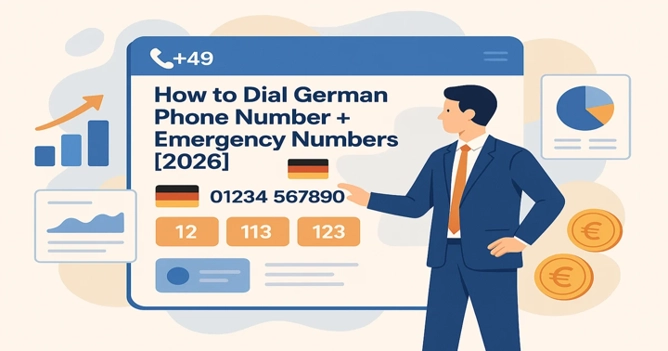
To dial a German phone number from abroad, you add the country code +49, drop the leading zero from the area code, and dial the rest of the number. That’s the core of it. German phone numbers don’t follow a single fixed length, which trips up a lot of newcomers. Area codes (Vorwahl, meaning the dialing prefix that identifies a geographic region or mobile network) run anywhere from two to five digits, and the total number length can reach up to eleven digits.
Back in 2019 in Freiburg, I spent an embarrassingly long time trying to figure out why my calls to a local Arztpraxis (doctor’s practice) kept failing. Turned out I was dialing the full number including the leading zero, which Germany drops when you dial internationally.
Mobile numbers in Germany typically start with prefixes like 015, 016, or 017. The 1522 prefix, for example, falls under Telekom and is one of the more common ones you’ll see. If someone gives you a deutschland phone number and you’re outside Germany, just replace that leading zero with +49. A Berlin phone number example would look like this internationally: +49 30 12345678, where 30 is Berlin’s Vorwahl.
According to Destatis, Germany had approximately 84.4 million residents registered in 2026, all reachable through a numbering system managed by the Bundesnetzagentur (Federal Network Agency, the authority responsible for allocating all German phone numbers). This guide covers how to dial any German number correctly, plus all emergency numbers including 112, the official emergency number for Europe.
In Germany, every mobile number starting with +49 1522 belongs to Deutsche Telekom’s network. It is not a geographic area code but a nationwide mobile identifier.
Parts of German Phone Numbers
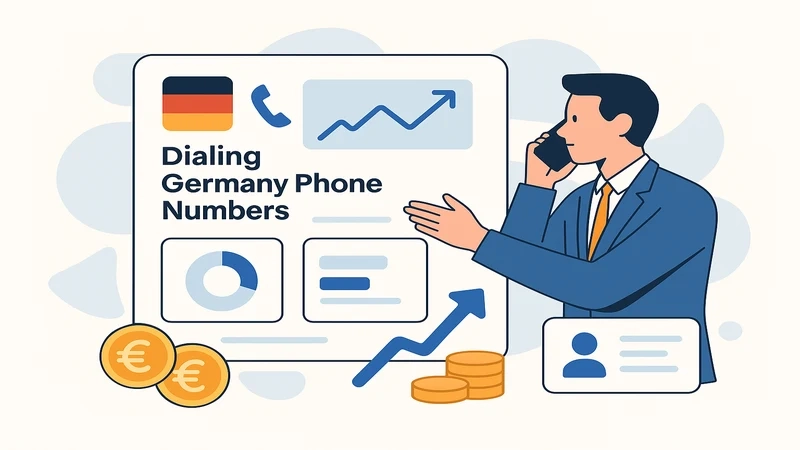
Every German phone number has three parts: the country code, the area code (Vorwahl), and the subscriber number. Understanding how these fit together makes dialing straightforward, whether you’re calling from abroad or within Germany.
Take +49 30 902760 as a concrete example. Here, +49 is Germany’s country code, assigned by the International Telecommunication Union (ITU, the United Nations agency that coordinates global telecommunications standards). 30 is the Vorwahl for Berlin. 902760 is the subscriber number. If you’re dialing from inside Germany, you drop the +49 and add a leading zero instead, making it 030 902760.
Mobile numbers follow the same structure but use different Vorwahl prefixes. +49 1522 3455662 breaks down as: +49 (country code), 1522 (a Telekom mobile prefix, often searched as the “49 1522 area code” or “1522 germany area code”), and 3455662 (the subscriber number). Mobile subscriber numbers tend to be longer than landline ones.
| Scenario | Format | Example |
|---|---|---|
| Calling from outside Germany | +49 + area code + number | +49 30 902760 |
| Calling from inside Germany | 0 + area code + number | 030 902760 |
| Written formally | +49 (0) 30 902760 | includes both variants |
Emergency Phone Numbers in Germany
Germany keeps its emergency system straightforward, but knowing which number to call before you need it matters more than most people realise.
110 is the police. Call it for crimes in progress, accidents, or any situation requiring law enforcement.
112 is the unified emergency number for medical emergencies, fire, and rescue services. This is also the pan-European standard. As an official 112 europe emergency number, it works from any phone across all EU member states, including on a phone with no SIM card or zero credit. According to the European Emergency Number Association (EENA), 112 is active in all 27 EU member states and is the single most widely recognised emergency number on the continent. If you are ever in doubt about which number to dial, 112 is always the right instinct.
115 connects you to the Bürgerservice (civil/public administration helpline, a centralised service for non-urgent government queries). It handles non-urgent government queries and will route you to the right authority if needed.
118xy numbers provide directory assistance. The suffix varies by provider.
One number people frequently overlook: 116 117 is the Kassenärztliche Vereinigung (statutory medical on-call service, which coordinates out-of-hours GP cover across Germany) for non-life-threatening medical situations outside regular GP hours. Think flu symptoms at midnight, not chest pain.
Only call 110 or 112 for genuine emergencies. Misuse of emergency lines is a criminal offence under German law.
How to Get a German Phone Number?
How do you get a German phone number as an expat? You sign up with a mobile or landline provider in person or online, show a valid identity document, and in most cases you have a working number within the same day for prepaid or within a few days for a contract.
There is one firm rule: you must be living or working in Germany to register one. Providers are legally required to verify your identity, so expect to show your passport and sometimes proof of address (Meldebestätigung, the official registration certificate you receive after completing your Anmeldung at the local residents’ office) when signing up.
For most expats, a prepaid SIM card is the fastest starting point. The three major networks are O2, Vodafone, and Telekom (T-Mobile), and they cover the bulk of the country, though 4G/LTE gaps still exist in rural areas as of 2026. According to the Bundesnetzagentur, Telekom’s LTE network covered approximately 99% of the German population as of their most recent annual report, making it the widest-reach option for rural areas. If you want a contract (Handyvertrag, a monthly mobile subscription tied to a German address and bank account), you will need a German bank account and a registered address.
| Provider | Network Type | Coverage Strength | Best For |
|---|---|---|---|
| Telekom (T-Mobile) | 4G/5G | Strongest nationwide, best rural | Rural areas, frequent travellers |
| Vodafone | 4G/5G | Strong urban and suburban | City dwellers, data-heavy users |
| O2 (Telefónica) | 4G/5G | Good urban, weaker rural | Budget-conscious urban expats |
Need a Reliable Prepaid SIM Card in Germany?
Check out our detailed article on Best Prepaid SIM Cards in Germany.
Landline numbers work differently. They are typically bundled with a DSL or fibre internet contract, and your number will carry a local area code tied to your city. A Berlin phone number example would look like +49 30 XXXXXXX, where 030 is the Berlin prefix.
Mobile numbers follow a different format entirely. The prefix +49 1522, for instance, belongs to Telekom’s mobile network. The 49 1522 area code and 1522 Germany area code both refer to the same Telekom block, which is useful to know when you receive an unfamiliar call.
According to the Bundesnetzagentur (Federal Network Agency), all SIM card registrations in Germany require verified identity documents under § 111 TKG (Telekommunikationsgesetz, the German Telecommunications Act). There are no workarounds here.
How to Find a German Phone Number?
Finding a German phone number is straightforward once you know where to look. The go-to resource is Das Telefonbuch, the official German telephone directory covering both private individuals and businesses across the country. The site works in German and English, which makes it genuinely useful if your German is still a work in progress.
For business numbers specifically, Gelbe Seiten (Germany’s equivalent of the Yellow Pages) is worth bookmarking. If you need to look up a government office or public authority, the official city or district website will almost always list direct contact numbers by department.
One thing worth knowing: Germany has strict data protection rules under the DSGVO (Datenschutz-Grundverordnung, the German implementation of GDPR), which means many private individuals opt out of public directories entirely. So if you cannot find a private number, that is usually the reason rather than any gap in the directory itself.
Virtual Phone Numbers in Germany
A virtual phone number is a real, dialable number. It just isn’t tied to a physical SIM card or a landline socket. Instead, calls go through an app on your phone, tablet, or laptop. For anyone running a small business or freelancing from Germany, this setup is genuinely useful.
The calling experience for whoever dials you is identical to calling a standard German number. You can also configure call forwarding so incoming calls land on your regular mobile. Whether the forwarded caller sees your virtual number or your actual mobile number depends entirely on your app settings.
Germany offers two types of virtual numbers worth knowing about. City numbers carry a standard Ortsvorwahl (local area code, the geographically assigned prefix for a specific German city or district), so a virtual Berlin number would follow the same format as any other Berlin phone number example, starting with 030. These give smaller businesses a local presence without renting office space. National numbers, by contrast, start with the two digits 32 and aren’t tied to any particular city. German companies often use these to give customers a single point of contact regardless of where the business actually operates.
How much does a virtual German phone number cost? As of 2026, entry-level virtual number plans from German providers generally start around €5–10 per month, though business-tier packages with CRM integrations run considerably higher. Pricing depends on the provider and which features you activate. Monthly packages, call forwarding, and add-on services all affect the final cost. Call forwarding is typically billed at the same rate as a standard local call within Germany.
Concluding Remarks
Getting German phone numbers right comes down to one thing: format. Always lead with the country code (+49 or 0049), drop the leading zero from the area code, then dial the rest. Whether you’re calling a Berlin landline, decoding what the 49 1522 area code or 1522 Germany area code means (it’s a Telekom mobile prefix), or just trying to reach emergency services, the structure stays consistent across every Deutschland phone number.
Speaking of emergencies, 112 is the official emergency number across Germany and the broader EU. According to the European Emergency Number Association (EENA), 112 is active in all EU member states, making it the standard 112 Europe emergency number official services recommend for travelers. In Germany specifically, 112 connects you to fire and medical services, while 110 reaches the police.
Back in 2019 in Freiburg, I genuinely did not know whether to dial 110 or 112 the first time I needed help. Both work. Knowing that in advance would have saved me a stressed minute.
One final practical note: if you’re dialing a German number from abroad and it isn’t connecting, double-check that you’ve removed the trunk zero (the leading 0 in the area code, which is only used for domestic dialing inside Germany). That single digit causes more failed calls than anything else.

Jibran Shahid
Hi, I am Jibran, your fellow expat living in Germany since 2014. With over 10 years of personal and professional experience navigating life as a foreigner, I am dedicated to providing well-researched and practical guides to help you settle and thrive in Germany. Whether you are looking for advice on bureaucracy, accommodation, jobs, or cultural integration, I have got you covered with tips and insights tailored specifically for expats. Join me on my journey as I share valuable information to make your life in Germany easier and more enjoyable.