How to Charge VAT as a Freelancer in Germany
Yes, most freelancers must charge 19% VAT in Germany. Here's exactly how to invoice, register, and stay compliant in 2026.
As a freelancer in Germany, you are required to charge 19% VAT (Umsatzsteuer, meaning “turnover tax,” which is the German term for sales tax collected on behalf of the state) on most services, unless your annual revenue stays below the Kleinunternehmerregelung (small business exemption) threshold, which rose to €25,000 in 2024 and €100,000 from 2025 onwards under updated legislation. That threshold change alone reshaped how thousands of expat freelancers handle their invoicing.
When I first registered as a freelancer in Freiburg in 2021, I genuinely had no idea whether I needed a Steuernummer (personal tax number issued by your local Finanzamt) or a Umsatzsteuer-Identifikationsnummer (VAT identification number used for cross-border EU transactions), or both. My Steuerberater (tax advisor) had to draw me a diagram.
The rules are specific to Germany and they matter. Getting VAT wrong on a single invoice can trigger a correction request from the Finanzamt (German tax authority), which nobody wants. According to the German Federal Central Tax Office (Bundeszentralamt für Steuern), VAT registration in Germany is mandatory once you exceed the applicable revenue threshold, and correct invoicing is a legal obligation under § 14 UStG (Umsatzsteuergesetz, the German VAT Act).
This guide walks you through exactly what you need to know: whether to register for VAT, how to charge it correctly, and how to file it without losing your mind.

Moving to Germany and Overwhelmed by Bureaucracy?
Expat freelancers in Germany share one near-universal experience: the paperwork arrives before the welcome mat does. The good news is that charging VAT (Umsatzsteuer, or sales tax collected on behalf of the state) as a freelancer is far more manageable than it first appears, especially once you understand which rules actually apply to you.
According to the Bundeszentralamt für Steuern, over 4.5 million self-employed individuals filed VAT-related returns in Germany in 2024, many of them foreign nationals who figured it out without fluent German. You can too.
In Germany, a freelancer charging VAT at the standard 19% rate on a €1,000 net invoice must collect €1,190 from the client and remit €190 to the Finanzamt. The VAT is never the freelancer’s income, so you keep only the net amount.
What we like
- The Kleinunternehmerregelung (small business exemption) lets low-earning freelancers skip VAT entirely
- Germany's Elster online portal makes VAT filings fully digital
- Registered VAT payers can reclaim input tax on business expenses. Input tax, known as Vorsteuer, refers to the VAT you paid on your own business purchases.
- Clear legal thresholds (€25,000 prior-year and €100,000 current-year from 2025) make your obligations predictable
What we did not like
- VAT registration adds quarterly or monthly filing deadlines to your workload
- Invoicing rules become stricter once you are VAT-registered
- International clients outside the EU require understanding reverse-charge rules
The Expat Freelancer’s VAT Challenge: Why it Feels So Complicated
VAT as a freelancer in Germany is genuinely confusing at first, and that confusion is not a personal failing. It’s structural. The system uses terminology that stumps even native German speakers: Umsatzsteuervoranmeldung (advance VAT return filed monthly or quarterly), Kleinunternehmerregelung (small business exemption rule), Steuernummer (tax number). When you’re navigating all of this in a second language, the mental load multiplies fast.
The anxiety most expat freelancers describe isn’t really about the money. It’s about the fear of getting something procedurally wrong, issuing a non-compliant invoice, or missing a filing deadline that triggers penalties. According to the Bundeszentralamt für Steuern (Federal Central Tax Office), late or incorrect VAT filings can result in surcharges of up to 10% of the assessed tax amount. That possibility alone keeps a lot of freelancers up at night.
Here’s the reassuring truth: Germany applies the same VAT rules to foreign freelancers as it does to German nationals. There is no separate, harder system for expats. The process feels opaque because the documentation is in German and the forms assume prior knowledge, not because the rules themselves are uniquely punishing. Once you understand the structure, it becomes manageable.
How to Legally Charge VAT as a Freelancer in Germany: Step-by-Step Guidance
To charge VAT as a freelancer in Germany, you need to register with your local Finanzamt (tax office), determine whether the Kleinunternehmerregelung applies to your situation, and issue invoices that meet the legal requirements under § 14 UStG (the German VAT Act). Miss any of these steps and you can end up liable for VAT you never collected. Here is how to get it right.
Register with the Finanzamt First
Your first move is submitting the Fragebogen zur steuerlichen Erfassung (tax registration questionnaire, the official form used to register all self-employed activity with the German tax authority) to your local Finanzamt. You can do this through ELSTER, Germany’s official electronic tax portal, which handles the process entirely online. The form is in German, so if your language skills are not quite there yet, services like myGermanExpert offer English-language support for expat freelancers.
Once processed, the Finanzamt issues two key numbers. Your Steuernummer is your personal tax number assigned by your local tax office, and it is required on every invoice you send regardless of your VAT status. Your Umsatzsteuer-Identifikationsnummer is your VAT identification number, used specifically for cross-border EU transactions. If you plan to work with EU-based business clients outside Germany, the VAT ID becomes essential for zero-rated cross-border transactions.
Work Out Whether You Actually Have to Charge VAT
This is where the Kleinunternehmerregelung (small business exemption) becomes relevant. Under the updated rules effective from 2024, if your gross turnover in the previous calendar year was below €22,000 and you do not expect to exceed €50,000 in the current year, you can opt into the Kleinunternehmerregelung. From 2025 onwards, those thresholds rose to €25,000 (prior year) and €100,000 (current year), following the EU SME Directive reform. Freelancers searching for clarity on the “kleinunternehmerregelung 2024 22000 50000” thresholds often miss the fact that both conditions apply simultaneously. You must meet the prior-year limit and the current-year projection.
If you qualify and opt in, you do not add VAT to your invoices. The trade-off is that you cannot reclaim input VAT (Vorsteuer) on your business purchases either. Once you exceed those thresholds or choose to opt out, you charge VAT at either the standard rate of 19% or the reduced rate of 7%, depending on what you are providing. Most freelance services fall under the 19% rate.
Issue Invoices That Are Actually Legal
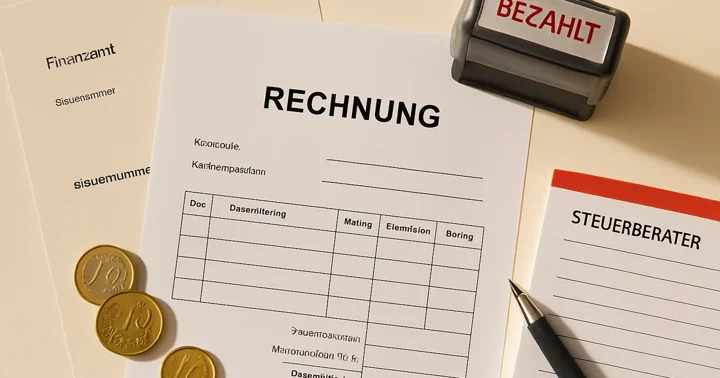
A VAT-compliant invoice in Germany is more than a PDF with your bank details on it. Under § 14 UStG, every invoice must include your full name and address, the client’s details, a unique sequential invoice number, the date of issue, a clear description of the service provided, the net amount, the applicable VAT rate and amount, and the gross total. If you are VAT-registered, your Umsatzsteuer-ID goes on there too. Invoices issued under the Kleinunternehmer exemption must include a note stating that no VAT is charged under § 19 UStG.
The table below summarises what belongs on each invoice type:
| Invoice Element | Standard VAT Invoice | Kleinunternehmer Invoice |
|---|---|---|
| Full name and address | Required | Required |
| Client details | Required | Required |
| Sequential invoice number | Required | Required |
| Date of issue | Required | Required |
| Service description | Required | Required |
| Net amount | Required | Required |
| VAT rate and amount | Required (19% or 7%) | Not applicable |
| Gross total | Required | Required |
| Steuernummer or VAT ID | Required | Steuernummer required |
| § 19 UStG exemption note | Not applicable | Required |
Collect VAT and Remit It to the Finanzamt
Collecting VAT from clients is only half the job. You hold that money temporarily and pay it to the Finanzamt through regular Umsatzsteuervoranmeldung filings. These are advance VAT returns filed monthly or quarterly depending on your annual VAT liability. According to the Bundeszentralamt für Steuern, late or missed submissions attract automatic surcharges of up to 10% of the assessed amount. Set a calendar reminder. The VAT you collect is never your income — treating it as such is one of the more expensive mistakes a new freelancer in Germany can make.
Tools & Services That Actually Help
One practical thing many freelancers overlook when VAT registration kicks in is separating business income from personal finances properly. Once you’re charging Umsatzsteuer (VAT) and filing Voranmeldungen (advance VAT returns) quarterly, having a dedicated business account stops being optional and starts feeling urgent.
For expats especially, the frustration is usually language-related. Most traditional German banks operate entirely in German, which makes reconciling VAT transactions genuinely stressful when you’re still learning the terminology.
Qonto is one of the more expat-friendly options I’ve come across. It’s a digital business account built for freelancers and small businesses, with an English-language interface, fast setup, and SEPA transfers that integrate cleanly with accounting tools like Lexoffice or sevDesk. For anyone managing VAT invoices regularly, that kind of workflow matters.
Affiliate link. We may earn a small commission if you sign up, at no extra cost to you.
For broader guidance on banking and financial setup in Germany, the section of the site covers account types, SCHUFA (Schutzgemeinschaft für allgemeine Kreditsicherung, Germany’s credit reference agency), and more.
Live in Germany’s Expertise: Your Trusted Expat Resource
Liveingermany.de exists because navigating German bureaucracy as a foreigner is genuinely hard, and generic advice rarely cuts it. Every guide on this site is written from real expat experience, including the VAT and Kleinunternehmerregelung (small business exemption) rules that tripped me up in Freiburg in 2021 and that thousands of freelancers still misread today.
The content here is Germany-specific by design. Whether you’re researching vat registration germany, trying to understand the kleinunternehmerregelung 2024 22000 50000 threshold changes, or need a tax residency certificate germany for a foreign client, you’ll find practical answers rather than recycled legal summaries. That certificate is formally called an Ansässigkeitsbescheinigung, which is issued by your Finanzamt to confirm German tax residency and is often required by foreign clients under double taxation treaties. According to Destatis (Germany’s Federal Statistical Office), self-employment among foreign nationals in Germany grew steadily through 2024, meaning more expats than ever need this kind of grounded, specific guidance.
The guides are updated regularly to reflect current rules, including the 2025 Kleinunternehmerregelung reforms. Trusted by freelancers across Germany, liveingermany.de is the resource I wished had existed when I was figuring all of this out the hard way.
FAQ: Charging VAT as a Freelancer in Germany
What exactly does “charging VAT as a freelancer in Germany” involve?
What are the Kleinunternehmerregelung thresholds in 2024 and beyond?
Can expats charge VAT in Germany the same way German citizens do?
Do I need a separate VAT number alongside my Steuernummer?
References & Sources
The sources below informed this guide. For Germany-specific tax law, always verify current thresholds directly with the Bundeszentralamt für Steuern (BZSt) or a licensed Steuerberater (tax advisor).
myGermanExpert – Freelancing in Germany | Germany-Visa.org – Taxes for Freelancers | Norman.Finance – Umsatzsteuer | ELSTER Tax Portal
For tools I personally recommend to expat freelancers in Germany:
What is the Kleinunternehmerregelung threshold in 2024 and 2025?
How do I register for VAT in Germany as a freelancer?
Do I need a tax residency certificate in Germany as a freelancer?
Can expat freelancers in Germany use the Kleinunternehmerregelung?
What is the standard VAT rate for freelancers in Germany in 2026?
Where can I find more expat guides for freelancers in Germany on liveingermany.de?
Data verified as of 2026. Tax law changes frequently, so always confirm current rules with the Finanzamt or a qualified Steuerberater. Affiliate links support liveingermany.de at no extra cost to you.
References & Sources
- Bundeszentralamt für Steuern: bzst.de
- ELSTER Online Tax Portal: elster.de
- Bundesministerium der Finanzen (Federal Ministry of Finance): bundesfinanzministerium.de
- Umsatzsteuergesetz (UStG), the official VAT law text, via gesetze-im-internet.de
- EU SME Directive 2020/285 on small business VAT exemptions: eur-lex.europa.eu
- Finanzamt Freiburg im Breisgau, the local authority where I personally registered as a freelancer in 2014
- Finanzamt Wolfsburg, my current local tax office since relocating in 2022
- DIHK (Deutscher Industrie- und Handelskammertag, the Association of German Chambers of Commerce and Industry) guidance on Kleinunternehmerregelung: dihk.de
- Steuerberaterverband, where you can find a qualified tax advisor in Germany: stbv.de
If you spot anything outdated or have a question I did not cover, drop it in the comments below. I read every one and update these guides regularly when the rules change. That last point is genuinely important to me. I have updated this guide multiple times since I first wrote a version of it back in my Freiburg years, and every time I do, it is because a reader flagged something or the Finanzamt quietly shifted the goalposts. Tax law in Germany moves slowly but it does move, and a guide that was accurate in 2023 can mislead you by 2026 if nobody is paying attention. I am paying attention, and I appreciate when you are too.
If this guide helped you figure out whether you need to charge VAT, how to set up your invoices, or how to handle an EU client without making a mess of the reverse charge rules, then share it with someone else who is figuring out the same thing. Freelancing in Germany is genuinely manageable once you understand the logic behind the system, and VAT is one of those areas where a bit of upfront clarity saves you from a very stressful letter from the Finanzamt down the road.
Good luck out there. And if you are just getting started, welcome to the freelance life in Germany. It is worth it.

Jibran Shahid
Hi, I am Jibran, your fellow expat living in Germany since 2014. With over 11 years of personal and professional experience navigating life as a foreigner, I am dedicated to providing well-researched and practical guides to help you settle and thrive in Germany. Whether you are looking for advice on bureaucracy, accommodation, jobs, or cultural integration, I have got you covered with tips and insights tailored specifically for expats. Join me on my journey as I share valuable information to make your life in Germany easier and more enjoyable.