Advance VAT Return Guide for Expats
File your Umsatzsteuervoranmeldung correctly in 2026. Avoid the 5 costly errors expats make and meet every quarterly deadline without stress.
Advance VAT Return (Umsatzsteuervoranmeldung) in Germany: A Step-by-Step Guide for Expats
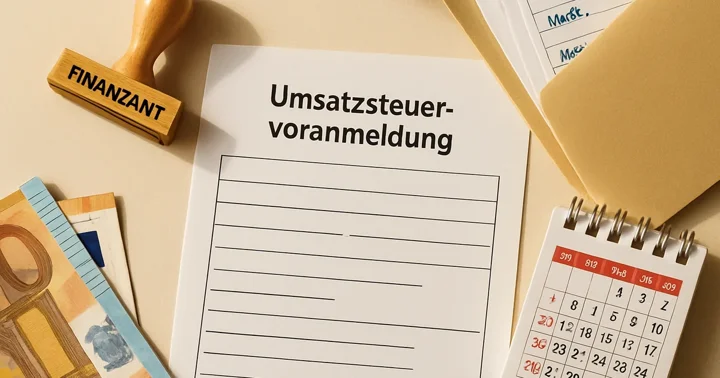
Every VAT-registered freelancer or business owner in Germany must file an Umsatzsteuervoranmeldung (advance VAT return) electronically via ELSTER, the official tax portal run by Germany’s Finanzverwaltung (tax administration). You file either monthly or quarterly depending on your situation. Missing a deadline triggers an automatic late-filing surcharge of up to 10% of the assessed tax, according to § 152 AO (Abgabenordnung, Germany’s General Tax Code).
When I started freelancing in Freiburg in 2021, the Umsatzsteuervoranmeldung was genuinely the most confusing part of my tax life. I filed my first one three days late and got a letter I had to read four times before understanding it was a warning, not a fine.
The good news is the process is completely learnable. According to Destatis, around 4.4 million people in Germany were self-employed in 2024, and most of them navigate this system without professional help every single quarter. This guide covers everything you need to know: who must file, how often, what the numbers mean, and how to actually submit it without losing your mind.

Navigating German Bureaucracy: The Expat Challenge
Freelancing or running a business in Germany means engaging with a tax system that is detailed, structured, and genuinely unforgiving of missed deadlines. The Umsatzsteuervoranmeldung (advance VAT return) alone requires monthly or quarterly submissions via ELSTER (the official German tax portal), plus records kept for ten years under § 147 AO (Abgabenordnung, the German Fiscal Code). According to Destatis, over 4.3 million self-employed individuals operated in Germany in 2024, and a significant share are expats navigating all of this in a second language.
The challenge is not just paperwork. It is understanding which obligations apply to you specifically, what penalties follow a late submission, and how the Finanzamt (local tax office) expects your records structured. Getting that wrong costs real money.
What we like
- ELSTER is free to use and accessible 24/7 from any country
- Submitting on time builds a clean compliance record with your Finanzamt
- VAT collected is not your income, and reclaiming input tax can improve cash flow
- Clear legal framework under UStG (Umsatzsteuergesetz, Germany's VAT Act) means rules are consistent and predictable
What we did not like
- ELSTER's interface is in German only, with no official English version
- Late submissions trigger automatic Verspätungszuschläge (late-filing surcharges)
- Monthly filing cycles leave very little margin for error or learning time
The Advance VAT Return (Umsatzsteuervoranmeldung): What Every Expat Should Know
How does the advance VAT return work in Germany? Every VAT-registered business or freelancer must periodically declare VAT collected on sales and VAT paid on expenses, then pay or reclaim the difference via ELSTER. The Umsatzsteuervoranmeldung (advance VAT return) is a periodic declaration where you report your VAT collected on sales and the VAT you paid on business expenses. If you are registered as a business, freelancer, or Unternehmer (entrepreneur, i.e. anyone conducting commercial or professional activity independently) with German VAT liability, filing this return is mandatory. You will need a Steuernummer (tax identification number issued by your local Finanzamt) and, for cross-border transactions, a USt-IdNr (Umsatzsteuer-Identifikationsnummer, your EU VAT identification number).
How Often You File Depends on Your VAT Liability
How often do you need to file an advance VAT return in Germany? New businesses and freelancers file monthly during their first two calendar years, then potentially switch to quarterly based on prior-year VAT liability. New businesses and freelancers typically file monthly during their first two years. After that, if your total VAT liability in the previous calendar year was below €7,500, you may switch to quarterly filings. Below €1,000, you may be exempt from advance returns entirely. Your Finanzamt determines your filing frequency based on the prior year’s figures, so this is not something you choose freely.
What You Must Declare
Each return covers four core items. You report your total taxable revenue, any tax-exempt supplies such as exports to non-EU countries, reverse-charge transactions where your customer accounts for VAT, and your Vorsteuer (input VAT, meaning the VAT you paid on your own business purchases and are entitled to reclaim). The net position determines whether you owe the Finanzamt money or are due a refund.
Deadlines and the Dauerfristverlängerung
When is the advance VAT return due in Germany? Your return and payment are both due by the 10th day of the month following the reporting period. For example, March’s VAT must be filed and paid by April 10th. Missing this deadline triggers automatic late-payment interest under § 233a AO (Abgabenordnung, the German Fiscal Code).
You can apply through ELSTER, Germany’s official tax portal, for a Dauerfristverlängerung, which is a permanent one-month filing extension available to all registered businesses. Monthly filers who request this must also pay a Sondervorauszahlung (special advance payment), calculated as one-eleventh of the previous year’s total VAT liability.
What Happens When You’re Owed a Refund
If your Vorsteuer exceeds your output VAT in a given period, which is common in early trading months when startup costs are high, the Finanzamt owes you the difference. According to the Bundeszentralamt für Steuern (Federal Central Tax Office), refunds are typically processed within six to eight weeks, though this can take longer if your Finanzamt requests supporting documentation.
All invoices, bank statements, and export records must be retained for ten years under § 147 AO. This is not a suggestion. Filing itself must be done electronically through ELSTER, as paper submissions are not accepted.
Quotable fact: In Germany, a VAT-registered freelancer who misses a single advance VAT return deadline can face a Verspätungszuschlag (late-filing surcharge) of up to 10% of the assessed tax, capped at €25,000 per return under § 152 AO.
Actionable Checklist for Expats Handling the Advance VAT Return
Getting the Umsatzsteuervoranmeldung (advance VAT return) right comes down to preparation. Miss one step and you’re either paying penalties or scrambling to reconstruct records from memory. Neither is fun.
Start at the beginning: register your business and for VAT with your local Finanzamt (tax office). Without this, nothing else in the process is valid. Once registered, keep meticulous records of every sale and purchase, both digitally and on paper. Germany’s retention requirement is ten years for tax-relevant documents under § 147 AO, so don’t delete anything prematurely.
Each filing period, calculate the Vorsteuer (input VAT you’ve paid on business expenses) against the Umsatzsteuer (output VAT you’ve charged to customers). The difference is what you owe or can reclaim. File and pay through ELSTER, Germany’s official tax portal, before the deadline. Waiting until the last day is a habit that will eventually cost you, because ELSTER can have technical issues and the Finanzamt won’t accept that as an excuse.
If your filing volume is high or your schedule unpredictable, apply for a Dauerfristverlängerung (permanent one-month deadline extension) in advance. This buys you an extra month each period and costs only a small interest-equivalent special prepayment in most cases. Always download VAT return templates directly from the Bundesministerium der Finanzen to make sure you’re using the current version. It is Germany’s central authority for tax legislation. Forms change, and outdated templates get rejected.
For the right tools, digital accounting platforms can simplify your preparation significantly, though all final submissions must go through ELSTER. And pairing that with a business account designed for international founders makes the whole process far less painful.
Need a modern business account to manage your German VAT filings? Try Qonto Business — digital-first accounts, English support, and features built for entrepreneurs.
(Affiliate link — we may earn a commission at no extra cost to you.)
Want a flexible alternative? N26 Business offers sleek mobile banking with instant expense notifications, useful for staying on top of VAT-relevant transactions between filing periods. Learn more
(Affiliate link — we may earn a commission at no extra cost to you.)
| Account | Best for | English support | Key VAT-relevant feature |
|---|---|---|---|
| Qonto Business | Freelancers and small businesses | Yes, full English interface | Receipt capture, tax folder, DATEV export |
| N26 Business | Mobile-first freelancers | Yes, English app | Instant transaction notifications, spaces for VAT reserves |
Live in Germany: Your Trusted Expat Guide for German Bureaucracy
Navigating German tax obligations as a foreigner is genuinely hard. The terminology alone, from Umsatzsteuervoranmeldung (advance VAT return) to Dauerfristverlängerung (permanent deadline extension), can make even routine filings feel like an exam you never studied for. That’s exactly why liveingermany.de exists.
Every guide on this site is written by someone who has actually dealt with German bureaucracy firsthand, not a content agency working from a checklist. The advice here is specific, current, and built around the questions real expats and freelancers actually ask.
If the advance VAT return brought you here, you might also find these resources useful:
Hundreds of internationals already rely on liveingermany.de for practical, jargon-free guidance. If you want new guides, deadline reminders, and expat tips delivered directly to your inbox, the newsletter is the easiest way to stay informed. You can also share your own experience in the community forums. Your questions and insights genuinely help improve what gets published here.
Frequently Asked Questions
What exactly is the Umsatzsteuervoranmeldung (advance VAT return)?
Do expats have to file the same way as German nationals?
What happens if I miss a filing deadline?
Can I use accounting software instead of filing directly in ELSTER?
Final Thoughts: Take Charge of Your German Business Journey
The Umsatzsteuervoranmeldung (advance VAT return) genuinely becomes routine once you’ve filed it two or three times. The first submission feels overwhelming. The fifth feels like admin you knock out before lunch.
My honest final tip: set a recurring calendar reminder two weeks before each deadline. Late filings attract a Verspätungszuschlag (late payment surcharge) of up to 10% of the assessed tax, capped at €25,000, according to § 152 AO (Abgabenordnung, Germany’s General Tax Code). That is a penalty worth avoiding with a two-minute calendar entry.
If you want to go deeper on the broader German tax picture, the guide below is a solid next step.
How often do I file an advance VAT return in Germany?
What happens if I miss the Umsatzsteuervoranmeldung deadline?
Can I file the advance VAT return myself without a Steuerberater (certified tax adviser)?
What is the Dauerfristverlängerung and should I apply for it?
Do small business owners under the Kleinunternehmerregelung need to file?
Data verified as of 2026. This is not legal advice. Consult a certified Steuerberater for personal recommendations.
The German tax system rewards those who stay organised and penalises those who ignore deadlines. That is genuinely the simplest summary I can offer after years of navigating it myself, first as a freelancer in Freiburg and now running things from Wolfsburg.
You do not need to be an accountant to handle your Umsatzsteuervoranmeldung competently. What you do need is a clear understanding of the process, a reliable system for tracking your income and expenses, and the discipline to file on time every single period. ELSTER makes the technical side manageable. The conceptual side is what trips most expats up, and hopefully this guide has closed that gap.
If something still feels unclear, your local Finanzamt is often more approachable than people expect. You can call them, visit in person, or write via the ELSTER message system. They are not there to catch you out. They want compliant filings, and most officers will point you in the right direction if you ask genuinely.
And if your business is growing to the point where VAT returns feel like a real time burden, that is actually a good sign. That is the moment to bring in a Steuerberater so you can focus on the work that actually earns money.
Good luck with it. Germany asks a lot from its self-employed residents, but once the system clicks, it becomes routine rather than stressful. You will get there.

Jibran Shahid
Hi, I am Jibran, your fellow expat living in Germany since 2014. With over 11 years of personal and professional experience navigating life as a foreigner, I am dedicated to providing well-researched and practical guides to help you settle and thrive in Germany. Whether you are looking for advice on bureaucracy, accommodation, jobs, or cultural integration, I have got you covered with tips and insights tailored specifically for expats. Join me on my journey as I share valuable information to make your life in Germany easier and more enjoyable.