St. Martin's Day in Germany – Lantern Walks Explained [2026]
What is St. Martin's Day in Germany? The legend, the Laternenumzug, where to get a lantern (dm from €1.85) and what to expect on the night.
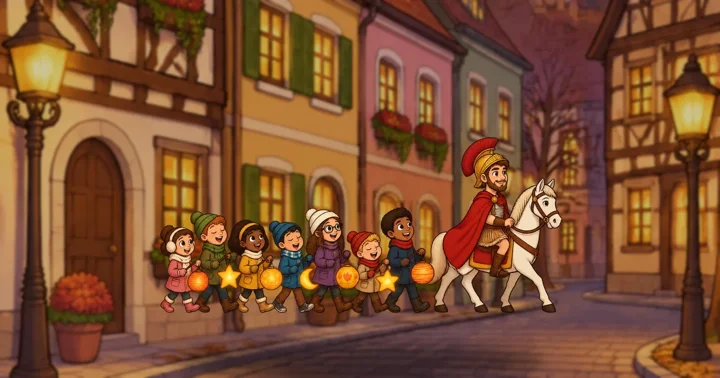
St. Martin’s Day (Martinstag) falls on 11 November, and on and around that date children all over Germany walk through the streets after dark with paper lanterns, singing songs and often following a rider dressed as Saint Martin. The walk is called a Laternenumzug (lantern parade). It is not a public holiday, it is free, and everyone is welcome, religious or not.
If your child goes to a Kita (daycare) in Germany, you will probably meet St. Martin before you understand it. One day in late October a paper lantern comes home half finished, your child starts humming a song you have never heard, and a note on the Kita door gives a date, a time “at dusk” and a meeting point. That is the moment most expat parents start searching for what St. Martin’s Day in Germany actually is.
This guide answers that in plain terms: the story behind the day, what happens at a typical lantern walk, where to get a lantern if your Kita doesn’t make one, and the songs your child will sing. We also made a one-minute video with Ali, his daughter Miriam and Oma Gisela, if you would rather watch first.
St. Martin lantern walks in Germany explained for expat parents
What Is St. Martin’s Day in Germany?
St. Martin’s Day honours Martin of Tours, a Roman soldier who later became a bishop and one of the best-known saints in Europe. In Germany the day is called Martinstag or Sankt Martin, and it is above all a children’s festival. The church side is still there, and many walks start with a short service, but for most families the day means lanterns, songs and a cold evening outside with the neighbours.
The date is fixed: 11 November every year. The walks are not. Each Kita, school, parish or neighbourhood picks its own evening, so in one town you can see lantern walks on several days in the week before and after the 11th. In 2026, 11 November was a Wednesday, and walks in many places continued into the following week.
In parts of northern Germany the event is often simply called the Laternenfest (lantern festival), and it has little religious framing at all. In the Rhineland and the Catholic south and west, the St. Martin figure on horseback and the church service are more common. The core is the same everywhere: children, lanterns, darkness, songs.
The Story of St. Martin and the Cloak
The legend every German child learns is short. Martin was a Roman soldier. One freezing winter night, at the gate of the city of Amiens, he rode past a beggar who had almost nothing to wear. Martin had no money with him, so he took his sword, cut his red soldier’s cloak in half and gave one half to the beggar.
That act of sharing is the whole point of the day. The lanterns are said to carry light into the dark, the way Martin’s kindness did, and that is the explanation your child will most likely bring home from the Kita. At many walks the scene is acted out: a rider in a red cloak and helmet stops, cuts a cloak in two and hands half to someone sitting at the roadside.
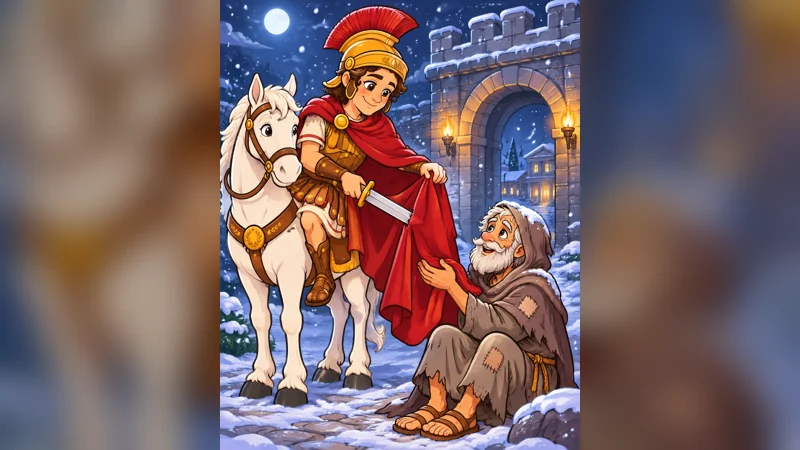
You don’t need to know more history than that to enjoy the evening. If your child asks why the man on the horse is cutting his coat, “he shared with someone who was cold” is the answer every German parent gives.
What Happens at a Lantern Walk (Laternenumzug)
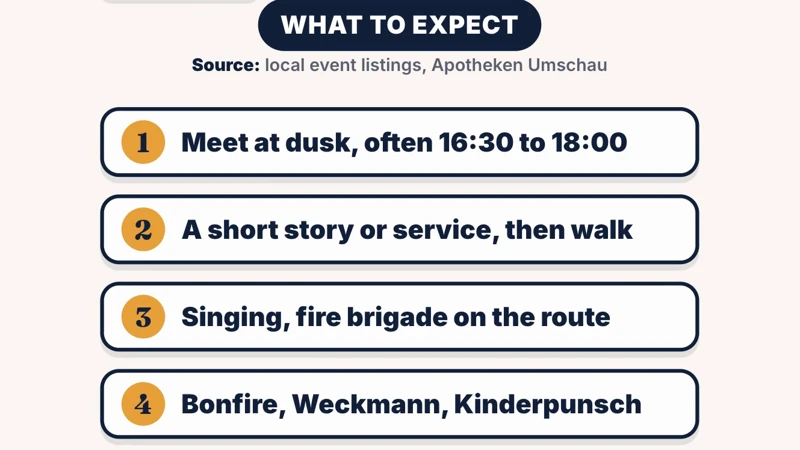
Every walk is organised locally, so details differ. Local event listings and reports from different regions show the same basic pattern:
- You meet at dusk. Start times in local listings sit roughly between 16:30 and 18:00. The Kita, school or parish notice tells you where, usually at the Kita itself, a church or a school yard.
- There is often a short story or service first. In a church this is usually a short children’s service. At a Kita it may be a small play of the cloak scene.
- Then everyone walks and sings. The children carry their lanterns, parents walk alongside, and the group stops now and then to sing. A rider playing St. Martin often leads the way.
- The fire brigade is often there. Volunteer firefighters (Freiwillige Feuerwehr) commonly secure the route, stop traffic at crossings and guard the bonfire at the end.
- Many walks end at a Martinsfeuer. That is a bonfire, usually with a Weckmann (a sweet yeast-bread man, also called Stutenkerl in some regions) for the kids and Kinderpunsch, a warm non-alcoholic fruit punch. Some walks also sell Glühwein for adults.
Plan for a full evening rather than a quick stop, and bring a little cash in case Weckmänner, Punsch or food are sold at the bonfire.
In some regions, especially in the west, children also go door to door after the walk singing St. Martin songs and are given sweets. This is called Martinssingen, and it is the reason many Germans dismiss Halloween as a copy of something they already have. It is regional, though, so don’t expect it everywhere.
Where to Buy a St. Martin Lantern
Ask the Kita first. Many Kitas make the lanterns with the children in the weeks before the walk, and some collect a small amount of money for materials. If your child’s group does this, you don’t need to buy anything except, perhaps, the light stick.
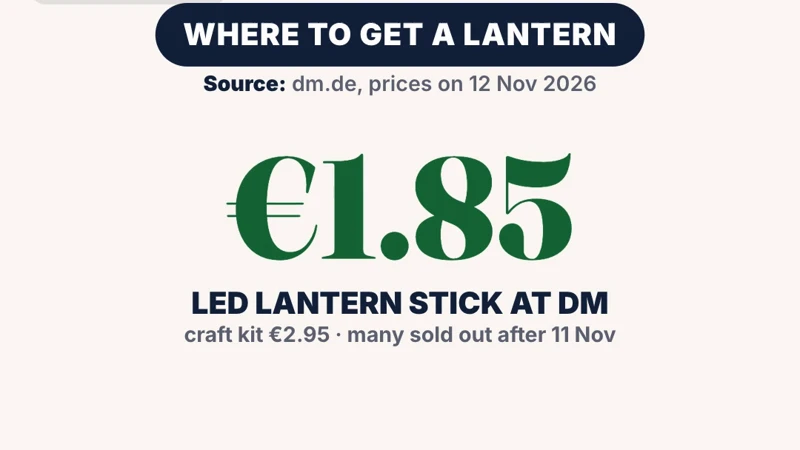
If you do need to buy one, drugstores are the easiest place. On 12 November 2026 we checked dm’s website:
- LED lantern stick (Laternenstab, 50 cm): €1.85
- Lantern craft kit: €2.95
- Wooden stick for a lantern: €0.55
Several of these items were already sold out online by 12 November, which tells you the main lesson: lantern season ends with the walks. If you want a lantern for next year, buy it in October, when drugstores, supermarkets and toy shops put out their seasonal shelves.
A note on the light: traditionally the lantern held a real candle. Today most families use a battery-powered LED stick because paper and flames don’t mix well with excited five-year-olds. Your Kita may say which it prefers. Either way, put fresh batteries in the stick before the evening and pack a spare set, because a dark lantern halfway through the walk is a real tragedy at that age.
St. Martin Songs Your Child Will Sing
The songs are the part that catches most expat parents off guard, because the children know every word and you don’t. These are the two you will hear at almost every walk:
- “Laterne, Laterne”: a very short, simple song about the lantern, the sun, the moon and the stars. Even toddlers sing along.
- “Ich geh mit meiner Laterne”: the classic walking song, with a repeating “Rabimmel, rabammel, rabumm” line that children love to shout.
Other common ones are “Sankt Martin, Sankt Martin”, which tells the cloak story, and “Durch die Straßen auf und nieder”. All of them are traditional folk songs, and you will find the lyrics and recordings easily by searching their titles. Learning even the first verse of “Laterne, Laterne” with your child before the evening goes a long way. It is also a gentle way to practise German together if you are raising your child with more than one language at home.
Food Around Martinstag: Weckmann and Martinsgans
Two foods belong to the day. For children, it is the Weckmann: a small man made of sweet yeast dough, often with raisin eyes and sometimes a little clay pipe. Bakeries sell them in the days around 11 November, and many lantern walks hand them out at the bonfire.
For adults, it is the Martinsgans, the St. Martin’s goose. Around 11 November many German restaurants offer roast goose with red cabbage and dumplings. It is a heavy, celebratory meal and popular for team dinners in November, so book a table if you want one.
Is St. Martin’s Day a Public Holiday in Germany?
No. St. Martin’s Day is not a public holiday anywhere in Germany. Shops, offices and schools are open as normal, and the lantern walks happen in the evening after work and Kita hours. That is also why the dates spread out: a Kita can pick whichever evening works for its families and its local St. Martin rider.
Tips for Your First Lantern Walk
- Check the notice early. The date, time and meeting point come from your Kita, school or parish, usually a couple of weeks ahead.
- Dress for standing still in the cold. You walk slowly and stand around the bonfire. Hats, gloves and warm shoes for everyone.
- Bring spare batteries for the LED stick, and a small bag in case the paper lantern gets wet or torn.
- Bring some cash for Weckmann, Punsch and food at the bonfire.
- Learn one song. “Laterne, Laterne” is enough to join in.
- Go even if you’re not religious. Nobody checks. For many families the walk is simply a neighbourhood evening, and it is one of the easiest ways for new families to meet other parents from the Kita.
Final Thoughts
St. Martin’s Day in Germany looks strange from the outside: hundreds of kids in the dark, singing, following a man on a horse. Once you have walked it once, it makes sense. It is a small, local, slightly chaotic evening built around a simple story about sharing, and it is one of the warmest German traditions you can take part in as a newcomer.
If this year’s walk has already passed, put a reminder in your calendar for early October: buy the lantern stick before the shelves empty, ask the Kita for the date, and learn the first verse of “Laterne, Laterne” with your child. Next year you’ll be the parent who knows the words.
What is St. Martin's Day in Germany?
When is St. Martin's Day in 2026?
Is St. Martin's Day a public holiday in Germany?
Do I need to be religious to join a lantern walk?
Where can I buy a St. Martin lantern in Germany?
What do you eat on St. Martin's Day in Germany?
What songs are sung on St. Martin's Day?
The illustrations in this guide and the video characters are AI-generated. Sources: dm.de (prices checked 12 November 2026), Apotheken Umschau, aponet, ZDFheute, evangelisch.de, t-online and local event listings.

Jibran Shahid
Hi, I am Jibran, your fellow expat living in Germany since 2014. With over 12 years of personal and professional experience navigating life as a foreigner, I am dedicated to providing well-researched and practical guides to help you settle and thrive in Germany. Whether you are looking for advice on bureaucracy, accommodation, jobs, or cultural integration, I have got you covered with tips and insights tailored specifically for expats. Join me on my journey as I share valuable information to make your life in Germany easier and more enjoyable.